Table of Contents
Chemical hazards remain one of the most underestimated workplace risks in Malaysia. From manufacturing plants and laboratories to healthcare facilities and construction sites, thousands of workers are exposed to hazardous chemicals every day. This is why Chemical Health Risk Assessment (CHRA) is not optional—it is a legal requirement under Malaysian law.
One of the most common questions employers ask is:
“How much does CHRA cost in Malaysia, and what affects the price?”
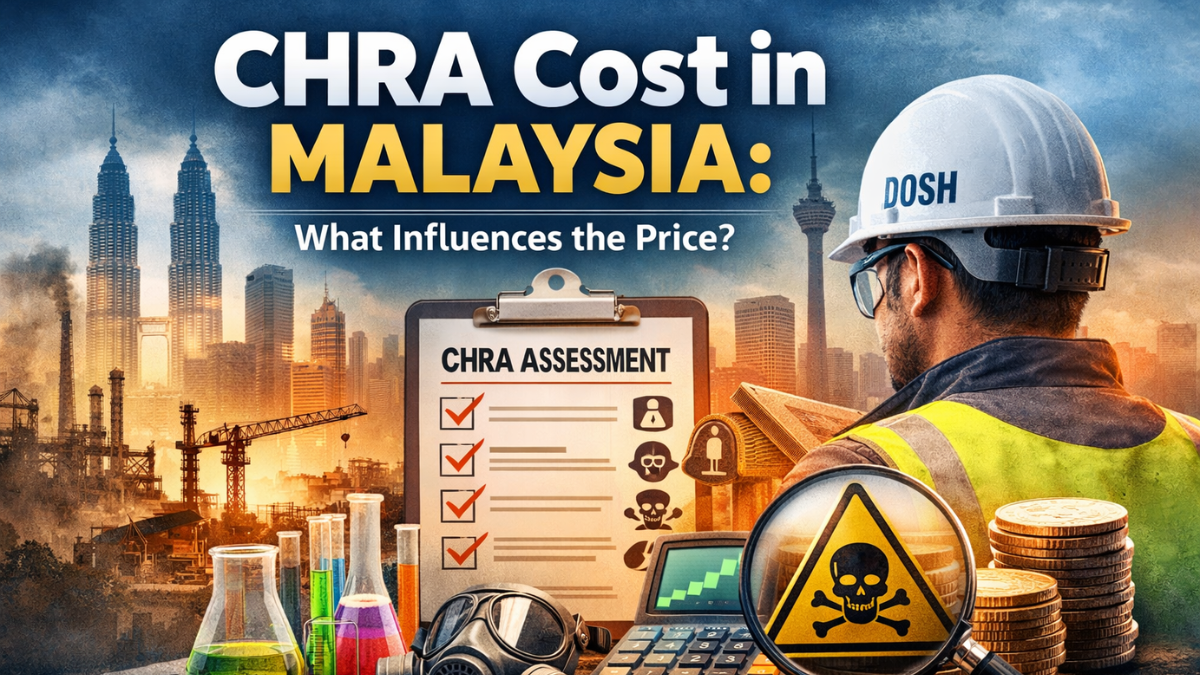
This article provides a complete, practical breakdown of CHRA cost in Malaysia, explains what influences pricing, and helps employers understand how to budget correctly while remaining fully compliant with DOSH requirements.
Key Takeaways:
CHRA cost in Malaysia is assessment-based, not fixed
The cost of a Chemical Health Risk Assessment varies depending on the number of chemicals used, workplace size, exposure complexity, and whether air monitoring is required. There is no standard flat rate under Malaysian regulations.Competency and compliance matter more than price
CHRA must be conducted by a DOSH-registered assessor. Choosing a low-cost or unqualified provider increases the risk of non-compliance, enforcement action, and the need for costly reassessments.CHRA is a long-term safety and compliance investment
A properly conducted CHRA supports legal compliance for up to five years, reduces occupational health risks, and helps employers avoid penalties, work stoppages, and reputational damage.
What Is CHRA and Why Is It Mandatory in Malaysia?
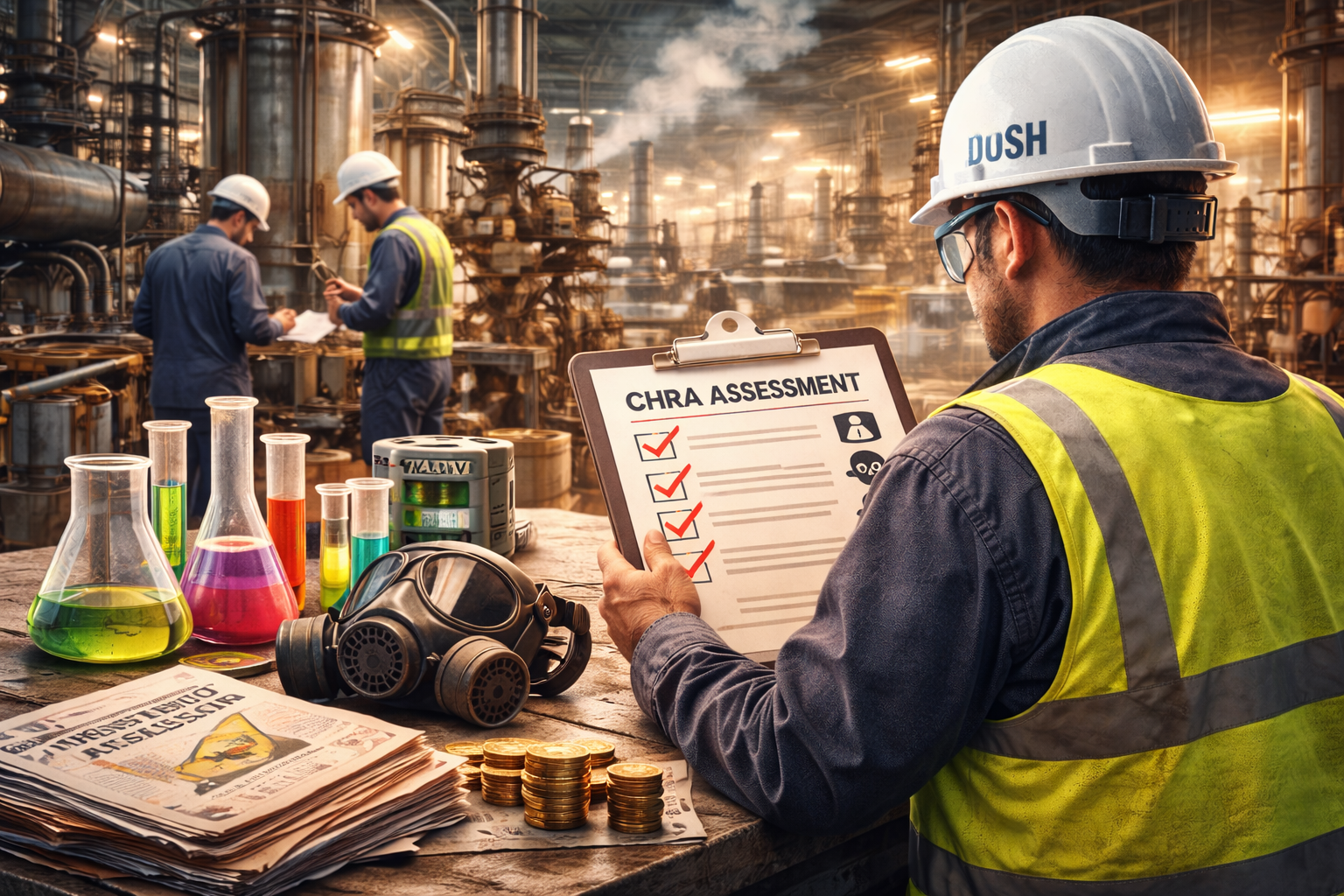
A Chemical Health Risk Assessment (CHRA) is a structured evaluation of chemical hazards in the workplace. Its purpose is to determine:
The types of hazardous chemicals present
How workers are exposed
The level of risk to employee health
Whether existing control measures are adequate
In Malaysia, CHRA is mandated under the Occupational Safety and Health (Use and Standards of Exposure of Chemicals Hazardous to Health) Regulations 2000 (USECHH Regulations), enforced by the Department of Occupational Safety and Health (DOSH).
Employers must conduct CHRA if:
Hazardous chemicals are used, handled, stored, or generated
Workers may inhale, ingest, or have skin contact with chemicals
Chemicals are classified as hazardous under CLASS Regulations or international standards
Failure to conduct CHRA is a direct legal offence, regardless of company size.
Key Factors That Influence CHRA Cost in Malaysia
1. Number of Chemicals Used
The more chemicals present, the more extensive the assessment.
Factors include:
Number of individual chemicals
Mixtures and by-products
Scheduled vs non-scheduled chemicals
Chemicals generated during processes (e.g. welding fumes, solvent vapours)
Each chemical requires:
Review of Safety Data Sheets (SDS)
Hazard classification
Exposure pathway analysis
More chemicals = more assessor time = higher CHRA cost.
2. Nature and Severity of Chemical Hazards
Not all chemicals carry the same level of risk.
Higher-risk substances significantly affect CHRA cost, including:
Carcinogens
Mutagens
Reproductive toxins
Highly toxic or corrosive substances
Sensitisers causing occupational asthma or dermatitis
Assessments involving these chemicals require:
More detailed exposure evaluation
Stricter comparison against permissible exposure limits (PEL)
Stronger justification of control measures
3. Workplace Size and Physical Layout
Larger and more complex workplaces increase assessment scope.
Considerations include:
Number of work areas and departments
Confined spaces vs open environments
Multiple floors or buildings
Ventilation systems and airflow patterns
A single-room facility is vastly different from a multi-line factory, directly impacting CHRA cost.
4. Number of Employees and Exposure Groups
CHRA does not assess individuals one by one. Instead, workers are grouped into Similar Exposure Groups (SEGs).
The more SEGs involved:
The more exposure scenarios must be analysed
The more observations and interviews required
The higher the documentation workload
Workplaces with rotating shifts, subcontractors, or varying tasks usually have higher CHRA costs.
5. Process Complexity and Work Practices
Chemical exposure risk increases with complex or manual processes.
Higher-cost CHRA scenarios include:
Manual chemical handling
Mixing or decanting chemicals
Open systems
Inconsistent work practices
Poor housekeeping or ventilation
Automated and enclosed processes usually reduce exposure complexity and assessment time.
6. Requirement for Air Monitoring and Sampling
One of the most significant contributors to CHRA cost is industrial hygiene monitoring.
CHRA may require:
Personal air sampling
Area air monitoring
Laboratory analysis of samples
Comparison against exposure limits
Air monitoring is required when:
Exposure cannot be reliably estimated
Existing controls are questionable
High-risk chemicals are present
Laboratory fees and equipment costs can substantially increase total CHRA cost.
7. Competency and Registration of the CHRA Assessor
Under Malaysian law, CHRA must be conducted by a DOSH-registered CHRA assessor.
Factors affecting cost:
Assessor’s experience
Industry specialisation
Depth of reporting
Quality of recommendations
Experienced assessors charge higher fees, but they also deliver:
More defensible reports
Clear compliance documentation
Practical risk reduction recommendations
Cheap assessments often fail during audits.
CHRA Cost vs Cost of Non-Compliance
Some employers attempt to reduce cost by delaying or avoiding CHRA. This is a high-risk decision.
Potential consequences of non-compliance:
DOSH enforcement notices
Stop-work orders
Compounds or prosecution
Occupational disease claims
Increased insurance premiums
Reputational damage
When compared against potential penalties and operational disruption, CHRA cost is minimal.
CHRA Cost vs Cost of Non-Compliance
Some employers attempt to reduce cost by delaying or avoiding CHRA. This is a high-risk decision.
Potential consequences of non-compliance:
DOSH enforcement notices
Stop-work orders
Compounds or prosecution
Occupational disease claims
Increased insurance premiums
Reputational damage
When compared against potential penalties and operational disruption, CHRA cost is minimal.
How Employers Can Optimise CHRA Cost
While CHRA cost cannot be eliminated, it can be optimised.
Practical cost-control measures:
Maintain a complete chemical inventory
Ensure updated Safety Data Sheets (SDS)
Standardise work practices
Group Similar Exposure Groups correctly
Improve ventilation and engineering controls before assessment
Well-prepared workplaces reduce assessor time, lowering overall cost.
Why CHRA Is More Than Just a Compliance Exercise
A properly conducted CHRA delivers value beyond compliance.
Benefits include:
Reduced occupational illness
Improved worker confidence
Better process control
Stronger safety culture
Improved audit readiness
Companies that view CHRA as an operational tool—not just a legal requirement—often see long-term cost savings.
Why Choose Advanced HSE Solutions for CHRA in Malaysia
Advanced HSE Solutions provides professional CHRA services tailored to Malaysian regulatory requirements.
Key advantages include:
DOSH-compliant CHRA assessors
Industry experience across manufacturing, healthcare, oil & gas, and construction
Clear, actionable reporting
Practical control recommendations
Integration with training and implementation support
The focus is not just assessment—but risk reduction and compliance sustainability.
Frequently Asked Questions (FAQ): CHRA Cost in Malaysia
Is CHRA mandatory for small businesses?
Yes. Company size does not exempt employers from CHRA obligations.
Can internal staff conduct CHRA?
No. CHRA must be conducted by a DOSH-registered assessor.
Does CHRA include air monitoring?
Only if required. Air monitoring depends on exposure complexity and risk level.
How long does a CHRA assessment take?
Typically from a few days to several weeks, depending on scope.
Is CHRA a one-time cost?
No. It must be reviewed or repeated every five years or after significant changes.
Conclusion: CHRA Cost Is an Investment in Safety and Compliance
Understanding CHRA cost in Malaysia requires looking beyond price alone. The true value lies in legal compliance, worker protection, and long-term operational stability.
A properly conducted CHRA:
Protects employees
Reduces legal exposure
Strengthens safety management systems
Employers should view CHRA not as an expense—but as a strategic investment in workplace health.
For organisations seeking compliant, professional, and practical CHRA services, Advanced HSE Solutions provides end-to-end support aligned with Malaysian regulatory expectations.