Table of Contents
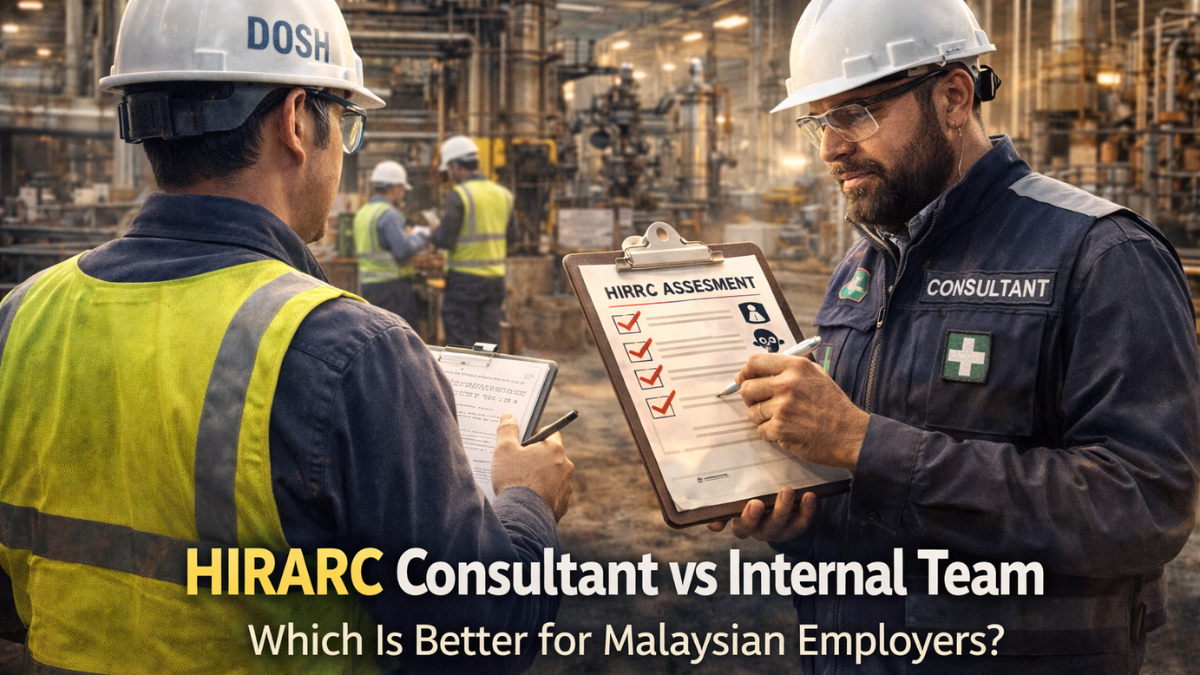
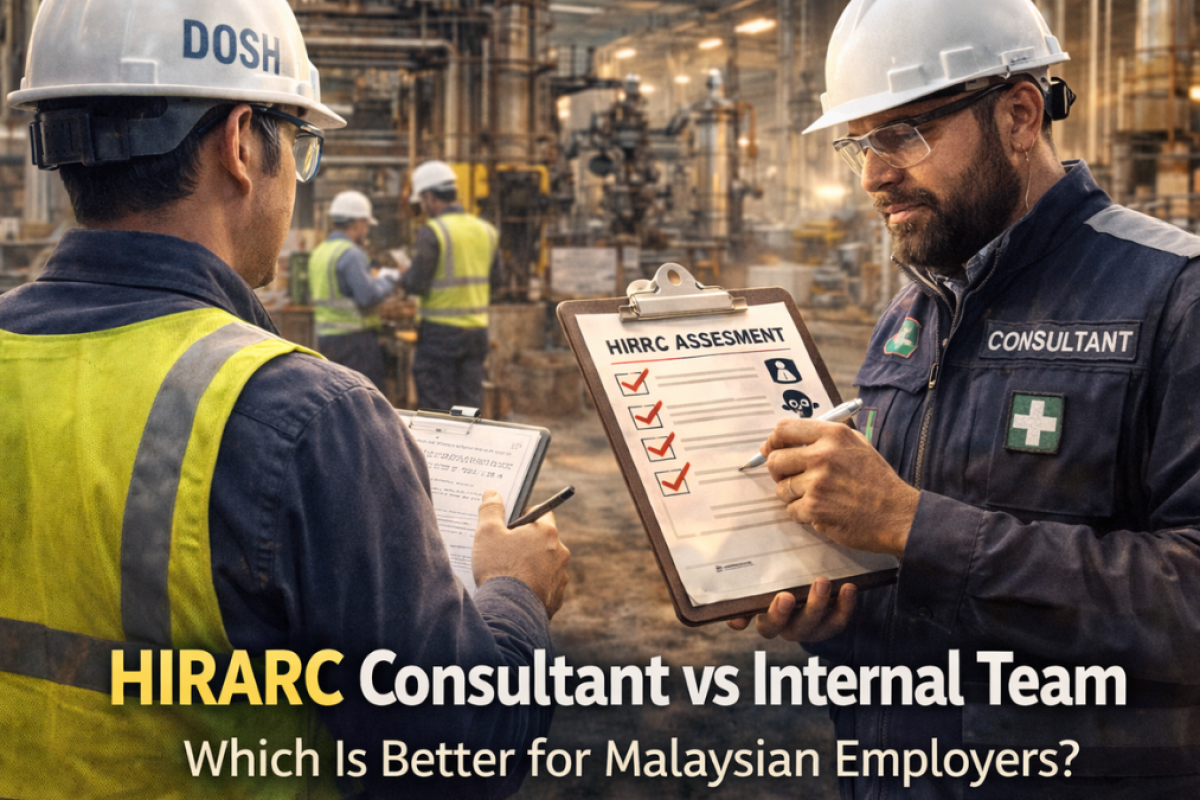
Hazard Identification, Risk Assessment and Risk Control (HIRARC) is one of the most fundamental pillars of occupational safety and health in Malaysia. Yet, despite its importance, many employers struggle with a critical decision:
Should HIRARC be conducted by an internal team, or is it better to engage a HIRARC consultant?
This question becomes even more important when organisations face DOSH inspections, audits, incidents, or operational changes. This article provides a practical, Malaysia-specific comparison between using an internal HIRARC team and hiring a HIRARC consultant, so employers can make an informed, defensible decision.
Key Takeaways:
A HIRARC consultant provides stronger compliance confidence than an internal team
While internal teams understand daily operations, HIRARC consultants bring independence, regulatory insight, and audit-ready documentation that significantly reduces the risk of DOSH non-compliance.Internal HIRARC may save cost short-term but increases long-term risk
Inadequate hazard identification, weak risk ranking, and inconsistent documentation often lead to rework, enforcement actions, or incident exposure—costs that far exceed engaging a competent HIRARC consultant.The most effective approach is often a hybrid model
Combining an experienced HIRARC consultant with internal team participation ensures accurate risk assessment, knowledge transfer, and sustainable long-term safety management tailored to Malaysian workplaces.
What Is HIRARC and Why Is It Mandatory in Malaysia?
HIRARC is a structured process used to:
Identify workplace hazards
Assess the level of risk associated with those hazards
Determine appropriate risk control measures
In Malaysia, HIRARC is a legal requirement under the Occupational Safety and Health Act 1994 (OSHA 1994) and reinforced through DOSH guidelines. Employers are legally obligated to identify hazards and take reasonably practicable steps to control risks.
HIRARC applies across all sectors, including:
Manufacturing
Construction
Oil & gas
Logistics and warehousing
Healthcare
Offices and commercial buildings
Failure to implement an effective HIRARC system exposes employers to enforcement action, accidents, compensation claims, and reputational damage.
The Core Question: HIRARC Consultant or Internal Team?
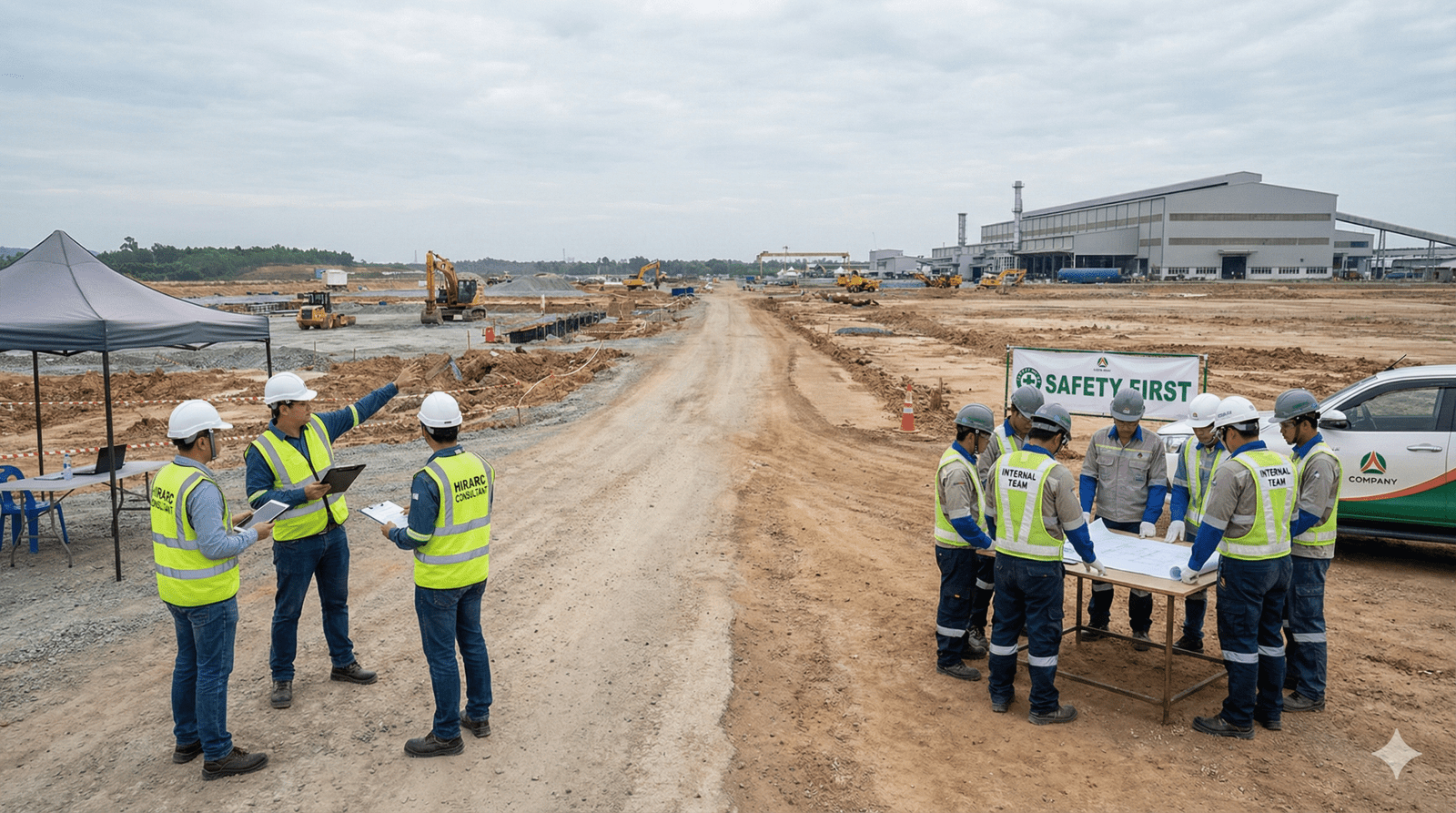
Most Malaysian organisations fall into one of these categories:
They rely entirely on an internal team (SHO, OSH Coordinator, supervisors)
They engage an external HIRARC consultant
They use a hybrid approach combining both
Each option has advantages and limitations. The right choice depends on risk profile, competency, industry complexity, and regulatory exposure.
Option 1: Conducting HIRARC Using an Internal Team
Who Typically Forms an Internal HIRARC Team?
Internal HIRARC is commonly conducted by:
Safety and Health Officer (SHO)
OSH Coordinator
Supervisors or engineers
Line managers with operational responsibility
In smaller organisations, HIRARC may be conducted by personnel with multiple roles, rather than dedicated safety professionals.
Advantages of an Internal HIRARC Team
1. Strong Familiarity with Daily Operations
Internal staff understand workflows, machinery, and routine practices. This familiarity allows them to identify hazards that external parties may initially overlook.
2. Lower Immediate Cost
There is no direct consultancy fee, making internal HIRARC appear more cost-effective in the short term.
3. Faster Access and Coordination
Internal teams can conduct reviews quickly without scheduling external site visits.
Limitations and Risks of Internal HIRARC
Despite its benefits, internal HIRARC carries several structural weaknesses.
1. Risk Normalisation and Bias
Long-term exposure to the same hazards often leads to complacency. Unsafe conditions become “normal”, resulting in under-estimated risks.
2. Limited Cross-Industry Perspective
Internal teams usually lack exposure to incidents, best practices, and regulatory trends across multiple industries.
3. Documentation Quality Issues
DOSH inspections frequently identify:
Generic hazard descriptions
Poor risk ranking justification
Weak linkage between hazards and controls
4. High Dependence on Individual Competency
If key safety personnel leave, HIRARC quality often deteriorates.
Option 2: Engaging a HIRARC Consultant
Who Is a HIRARC Consultant?
A HIRARC consultant is an external HSE professional or consultancy with experience conducting structured risk assessments across multiple workplaces and industries.
A competent HIRARC consultant understands:
DOSH expectations
Industry-specific hazards
Audit-ready documentation standards
Practical risk control hierarchy
Advantages of Hiring a HIRARC Consultant
1. Independent and Unbiased Assessment
External consultants bring a fresh perspective, free from internal pressure or operational blind spots.
2. Strong Regulatory Interpretation
HIRARC consultants are typically well-versed in:
OSHA 1994 requirements
DOSH enforcement trends
Audit and investigation expectations
3. Higher Quality Documentation
Consultant-prepared HIRARC reports are usually:
Structured and systematic
Evidence-based
Easily defensible during inspections
4. Practical Risk Control Recommendations
Experienced consultants recommend controls aligned with:
Hierarchy of control
Industry best practice
Reasonably practicable implementation
Common Concerns About Hiring a HIRARC Consultant
Some employers hesitate due to:
Perceived higher cost
Fear of overly theoretical assessments
Concern about limited understanding of site-specific operations
In practice, these issues can be mitigated by engaging a consultant who works collaboratively with internal teams.
Comparison Table 1: HIRARC Consultant vs Internal Team
| Aspect | Internal HIRARC Team | HIRARC Consultant |
|---|---|---|
| Operational familiarity | High | Moderate (site-based learning) |
| Independence | Low | High |
| Risk normalisation | Common | Minimal |
| Regulatory interpretation | Varies by individual | Strong and consistent |
| Cross-industry exposure | Limited | Extensive |
| Documentation quality | Inconsistent | Structured and audit-ready |
| Cost (short-term) | Lower | Higher |
| Cost (long-term risk) | Potentially high | Lower due to compliance strength |
Compliance and DOSH Inspection Confidence
One of the biggest differences between internal and consultant-led HIRARC emerges during DOSH inspections or investigations.
Internal HIRARC often:
Relies on simplified matrices
Lacks justification for risk ranking
Shows weak linkage between hazards and controls
HIRARC conducted or reviewed by a consultant typically:
Aligns clearly with DOSH expectations
Demonstrates reasonable practicability
Reduces enforcement exposure
Comparison Table 2: Audit and Inspection Readiness
| Criteria | Internal Team | HIRARC Consultant |
|---|---|---|
| DOSH audit readiness | Moderate to low | High |
| Risk ranking justification | Often weak | Clearly documented |
| Evidence of control effectiveness | Limited | Strong |
| Consistency across departments | Variable | Standardised |
| Defensibility during incidents | Weak | Strong |
Cost Consideration: Short-Term Savings vs Long-Term Risk
Many employers focus heavily on immediate cost, overlooking long-term exposure.
Internal HIRARC may appear cheaper, but hidden costs include:
Rework after inspections
Repeat assessments
Incident investigations
Legal and compensation costs
A HIRARC consultant helps reduce these downstream risks by getting the assessment right the first time.
When an Internal HIRARC Team May Be Sufficient
Internal HIRARC can be appropriate when:
The workplace is low risk (e.g. administrative offices)
Operations are stable with minimal change
Safety personnel are well-trained and experienced
Regular refresher training and reviews are conducted
Even in these cases, periodic external review is strongly recommended.
When a HIRARC Consultant Is the Better Choice
Engaging a HIRARC consultant is strongly advisable when:
Operations involve machinery, chemicals, or manual handling
The industry is high risk
New processes or facilities are introduced
Accidents or near misses have occurred
The organisation is preparing for DOSH inspection or certification
Internal competency is limited or overstretched
Comparison Table 3: Suitability by Scenario
| Scenario | Internal Team | HIRARC Consultant |
|---|---|---|
| Low-risk office | Suitable | Optional |
| Manufacturing plant | Risky | Strongly recommended |
| Construction site | Insufficient | Essential |
| New facility setup | Inadequate | Essential |
| After accident | Not advised | Highly recommended |
| DOSH enforcement history | High risk | Strongly recommended |
Hybrid Approach: The Most Sustainable Model
Many Malaysian organisations adopt a hybrid approach:
Consultant leads or validates the HIRARC
Internal team participates actively
Knowledge transfer occurs during assessment
This model:
Builds internal competency
Maintains independence
Reduces long-term reliance on consultants
Why Companies Choose Advanced HSE Solutions as Their HIRARC Consultant
Advanced HSE Solutions provides HIRARC services designed specifically for Malaysian regulatory expectations.
Key strengths include:
Practical, DOSH-aligned methodology
Experience across high-risk and regulated industries
Clear, implementable risk control plans
Strong documentation for audits and inspections
Support beyond assessment, including training and improvement planning
The focus is not only on compliance, but on real risk reduction.
Frequently Asked Questions (FAQ)
Is hiring a HIRARC consultant mandatory in Malaysia?
No, but employers must ensure HIRARC is effective, accurate, and defensible. Many internal HIRARC fail to meet this standard.
Can DOSH reject an internally prepared HIRARC?
Yes. DOSH may issue improvement notices if HIRARC is inadequate or poorly documented.
How often should HIRARC be reviewed?
HIRARC should be reviewed whenever there are changes, incidents, or at regular intervals as part of continuous improvement.
Does HIRARC include contractors and visitors?
Yes. HIRARC must consider all persons who may be affected by workplace hazards.
Conclusion: Which Is Better—HIRARC Consultant or Internal Team?
There is no one-size-fits-all answer. However, for most Malaysian employers—especially those in medium- to high-risk industries—a HIRARC consultant provides superior compliance confidence, risk visibility, and long-term protection.
Internal teams play a vital role, but independent professional input significantly strengthens the quality and defensibility of HIRARC.
For organisations seeking reliable, compliant, and practical HIRARC solutions, Advanced HSE Solutions offers the expertise required to protect both people and the business.