Table of Contents
Quick Answer
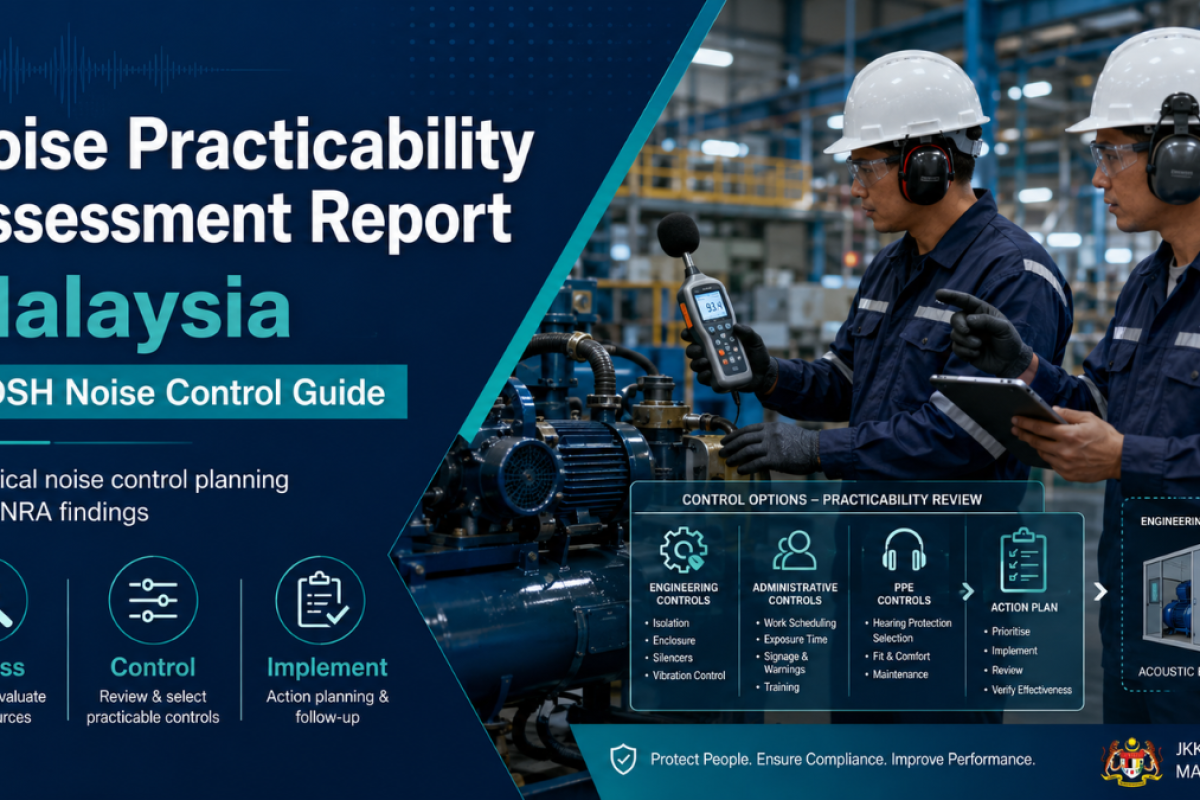
A Noise Practicability Assessment Report is a workplace noise control document used to assess whether proposed noise reduction measures are practical, suitable and reasonable for a workplace after excessive noise exposure has been identified.
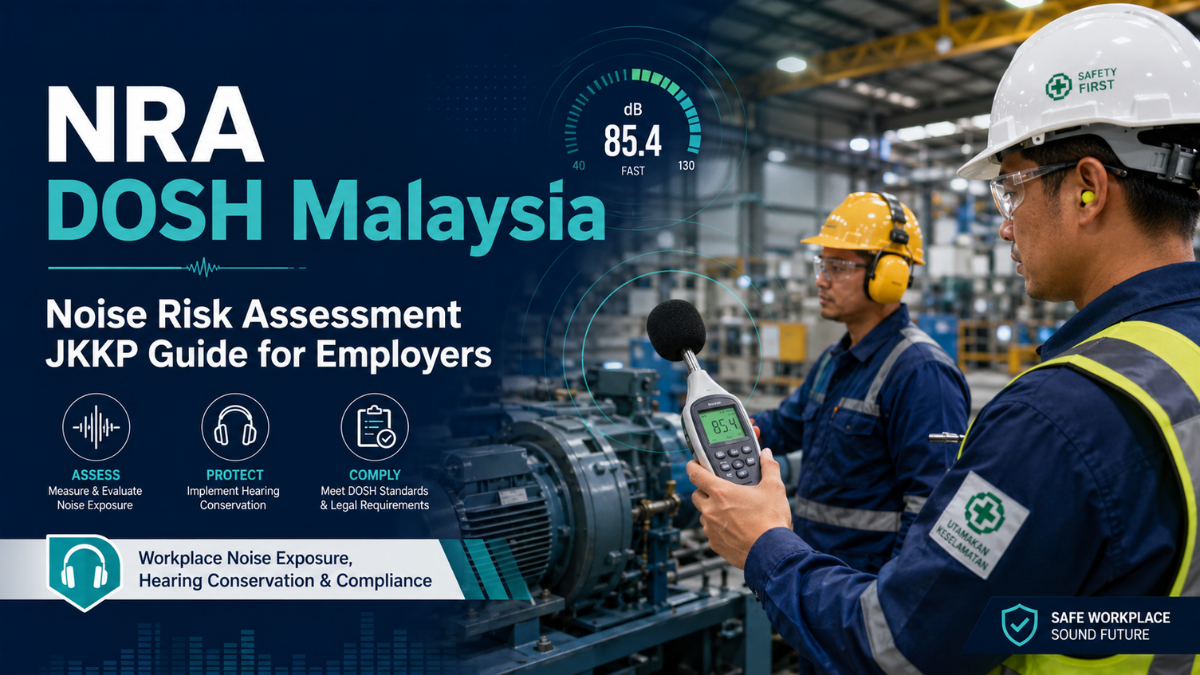
In Malaysia, this report is closely connected to the Occupational Safety and Health (Noise Exposure) Regulations 2019 and DOSH/JKKP guidance on occupational noise control.
Employers may need this report after a Noise Risk Assessment shows that employees are exposed to noise levels that require control measures. The report helps employers evaluate noise control options such as engineering controls, administrative controls and other practicable measures before relying only on hearing protection.
Key Takeaways:
- A Noise Practicability Assessment Report assesses practical noise control measures after excessive noise is identified.
- It is closely connected to NRA DOSH and Malaysia’s Noise Exposure Regulations 2019.
- The report helps employers decide whether engineering controls, administrative controls or other measures are practicable.
- Hearing protection should not be the only control if other noise reduction measures can be implemented.
- The report should include NRA findings, noise sources, control options, practicability evaluation and an action plan.
- Employers should document why control measures are selected, delayed or not practicable.
- The assessment should involve HSE, maintenance, production and management where needed.
- Follow-up monitoring is important to confirm whether controls reduce noise exposure.
- The report supports DOSH/JKKP inspection readiness and hearing conservation planning.
- Advanced HSE Solutions can support NRA review, noise control practicability assessment, action planning and compliance documentation.

What Is a Noise Practicability Assessment Report?
A Noise Practicability Assessment Report is a structured assessment report that reviews possible noise reduction measures and determines whether they are practicable for the workplace.
It is sometimes referred to as:
- Noise Control Practicability Assessment Report
- Noise Practicability Assessment
- Noise Control Assessment Report
- Practicability Assessment for Noise Control
- NCPAR
- DOSH Noise Practicability Report
- JKKP Noise Control Practicability Report
The main purpose is to help the employer decide what noise control actions should be implemented after excessive noise is identified.
In simple terms, the report answers this question:
“What practical steps can the employer take to reduce workplace noise exposure, and are those steps technically and operationally practicable?”
Why This Report Matters
Many employers complete a Noise Risk Assessment but stop after receiving the report. This is a common mistake.
A Noise Risk Assessment identifies the noise risk. A Noise Practicability Assessment Report helps the employer decide what to do next.
If excessive noise is identified, the employer should not only provide earplugs and consider the matter closed. The employer should assess whether noise can be reduced at source, along the transmission path or through changes in work organisation.
This is where the Noise Practicability Assessment Report becomes important.
It supports:
- DOSH/JKKP compliance
- Noise control planning
- Engineering control decision-making
- Administrative control planning
- Hearing conservation programme improvement
- Budget justification for noise control
- Internal audit and management review
- Follow-up action after NRA findings
How It Connects to NRA DOSH
Noise Practicability Assessment normally comes after Noise Risk Assessment.
The relationship is simple:
- Noise Risk Assessment identifies whether workers are exposed to excessive noise.
- The employer reviews the NRA findings.
- If noise exposure needs to be reduced, the employer assesses practicable noise control measures.
- The Noise Practicability Assessment Report documents the evaluation and recommended actions.
- The employer implements controls and monitors effectiveness.
NRA tells the employer where the noise risk is.
Noise Practicability Assessment helps the employer decide how to reduce the risk.
When Is a Noise Practicability Assessment Report Needed?
A Noise Practicability Assessment Report may be needed when a Noise Risk Assessment identifies excessive noise exposure and further noise control measures must be considered.
Common situations include:
- Workers are exposed above the noise exposure limit.
- The NRA report recommends noise control measures.
- High-noise areas are identified.
- Similar Exposure Groups show significant noise exposure.
- Existing controls are not enough.
- Workers rely mainly on earplugs or earmuffs.
- DOSH/JKKP requests evidence of noise control planning.
- The employer needs to justify why certain controls are or are not practicable.
- The workplace is planning engineering or administrative noise controls.
- Audiometric results suggest possible ongoing noise exposure concerns.
The report is especially useful when the solution is not straightforward and management needs a documented basis for decision-making.
Legal and Compliance Background
Malaysia’s occupational noise framework requires employers to manage excessive workplace noise.
When excessive noise is identified, employers are expected to reduce noise exposure through appropriate measures. Noise control should not automatically depend only on personal hearing protection.
The Noise Practicability Assessment Report supports this requirement by documenting the employer’s evaluation of possible noise reduction measures.
It shows that the employer has considered what can reasonably and practically be done to reduce noise exposure.
What Does “Practicability” Mean?
Practicability means whether a control measure can reasonably be implemented considering the actual workplace situation.
A practicability assessment may consider:
- Technical feasibility
- Noise reduction effectiveness
- Workplace layout
- Machinery design
- Production requirements
- Maintenance needs
- Safety implications
- Installation constraints
- Operational disruption
- Cost in relation to risk reduction
- Availability of suitable technology
- Time required for implementation
- Long-term sustainability
The report should not simply say “not practicable” without explanation. If a control is not practicable, the reason should be clearly documented.
What Should Be Included in a Noise Practicability Assessment Report?
A good report should be clear, practical and useful for management action.
It may include:
- Workplace background
- Relevant NRA findings
- Noise sources identified
- Affected areas or work units
- Affected Similar Exposure Groups
- Existing noise control measures
- Proposed engineering controls
- Proposed administrative controls
- Assessment of practicability
- Expected noise reduction
- Implementation priority
- Estimated timeline
- Person responsible
- Budget or resource considerations
- Interim control measures
- Personal hearing protection requirements
- Monitoring and review plan
- Conclusion and recommendations
The report should help the employer move from assessment to action.
Common Noise Control Measures to Assess
The practicability assessment should review suitable noise reduction options.
Engineering Controls
Engineering controls reduce noise at the source or along the transmission path.
Examples include:
- Replacing noisy machinery with quieter models
- Installing acoustic enclosures
- Installing acoustic barriers
- Using silencers or mufflers
- Adding vibration isolation
- Improving machine foundation
- Using damping materials
- Reducing impact noise
- Maintaining worn bearings, belts and rotating parts
- Enclosing compressors or generators
- Separating noisy equipment from workers
- Improving lubrication and preventive maintenance
- Redesigning process flow to reduce noise exposure
Engineering controls are usually preferred because they reduce exposure for multiple workers.
Administrative Controls
Administrative controls reduce exposure by changing the way work is organised.
Examples include:
- Reducing time spent in noisy areas
- Rotating workers where suitable
- Scheduling noisy tasks when fewer workers are present
- Restricting access to high-noise zones
- Creating hearing protection zones
- Displaying warning signage
- Separating noisy work from quiet work
- Planning maintenance during low-occupancy periods
- Training supervisors to control noise exposure
- Improving work procedures
Administrative controls can be effective, but they require discipline, supervision and proper documentation.
Personal Hearing Protection
Personal hearing protection may include:
- Earplugs
- Earmuffs
- Dual protection
- Custom-moulded hearing protectors
- Fit testing and user training
Hearing protection is important, but it should not be the only control if other noise reduction measures are practicable.
The report should clearly explain whether hearing protection is being used as an interim control, supplementary control or long-term control.
How Employers Should Prepare for the Assessment
Before preparing the Noise Practicability Assessment Report, employers should gather relevant information.
Useful documents include:
- Noise Risk Assessment report
- Noise maps
- Area noise measurement results
- Personal exposure results
- List of Similar Exposure Groups
- Machinery list
- Maintenance records
- Process flow
- Workplace layout
- Existing noise control records
- Hearing protection records
- Audiometric testing summary
- Production schedule
- Planned machinery upgrades
- Budget or capital expenditure plan
- Previous DOSH/JKKP correspondence, if any
The more complete the information, the more useful the report will be.
Noise Practicability Assessment Process
A practical process may include the following steps.
Step 1: Review the NRA Report
Start by reviewing the Noise Risk Assessment report.
Identify:
- Which areas exceed noise criteria
- Which workers are affected
- Which machines or processes are responsible
- Whether exposure is continuous, intermittent or peak-based
- Existing control recommendations
- Similar Exposure Groups requiring attention
This establishes the basis for the practicability assessment.
Step 2: Identify Noise Sources
The next step is to identify the main noise sources contributing to exposure.
Examples may include:
- Compressor
- Generator
- Blower
- Stamping machine
- Grinding process
- Cutting process
- Packaging line
- Conveyor system
- Pump or motor
- Pneumatic tool
- Air discharge
- Metal impact
- Construction equipment
Identifying the real noise source is important because control measures must target the source of exposure.
Step 3: List Possible Control Options
For each major noise source, list possible control measures.
For example:
- Can the equipment be enclosed?
- Can a silencer be installed?
- Can vibration be reduced?
- Can the machine be relocated?
- Can the worker be moved further away?
- Can noisy work be isolated?
- Can maintenance reduce noise?
- Can the process be replaced?
- Can work duration be reduced?
- Can access be restricted?
The assessment should not jump to the easiest option only. It should consider a reasonable range of controls.
Step 4: Assess Practicability
Each proposed control should be assessed for practicability.
Consider:
- Is the control technically possible?
- Will it reduce noise meaningfully?
- Will it create another safety risk?
- Can it be installed without major disruption?
- Is it compatible with the production process?
- Is it maintainable?
- Is the cost reasonable compared with the risk?
- Can it be implemented immediately or in phases?
- Is it suitable as a long-term control?
The report should clearly state why a control is recommended, delayed, modified or rejected.
Step 5: Prioritise Actions
Not all controls can be implemented at once.
Prioritisation may be based on:
- Highest exposure level
- Number of workers affected
- Severity of risk
- Feasibility
- Cost-effectiveness
- Quick wins
- Legal urgency
- DOSH/JKKP inspection requirements
- Audiometric concerns
- Business continuity impact
A practical report should separate immediate actions from medium-term and long-term actions.
Step 6: Prepare an Action Plan
The report should include a realistic action plan.
The action plan should include:
- Recommended control measure
- Area or machine involved
- Responsible person
- Target completion date
- Interim control measure
- Required budget or resources
- Follow-up monitoring plan
- Status tracking method
This makes the report easier for management to implement.
Step 7: Monitor Effectiveness
After controls are implemented, employers should check whether the measures actually reduce noise exposure.
This may involve:
- Follow-up noise measurement
- Worker feedback
- Review of hearing protection usage
- Review of audiometric results
- Maintenance checks
- Supervisor verification
- Internal audit
- Updated risk assessment
Noise control is not complete until effectiveness is verified.
Difference Between NRA and Noise Practicability Assessment Report
NRA and Noise Practicability Assessment Report are related, but they are not the same.
NRA identifies the noise hazard and exposure level.
Noise Practicability Assessment Report evaluates practical noise control options after the noise risk has been identified.
In simple terms:
- NRA answers: “How serious is the noise exposure?”
- Practicability assessment answers: “What can we realistically do to reduce it?”
Both documents are useful for DOSH/JKKP compliance and workplace noise management.
Difference Between Noise Control Plan and Practicability Assessment
A Noise Control Plan is an action plan for reducing noise exposure.
A Noise Practicability Assessment Report supports the plan by explaining which control measures were considered and why certain measures were selected.
The assessment helps justify the control plan.
For example, if acoustic enclosure is recommended, the practicability assessment should explain why it is suitable. If full enclosure is not practical, the report should explain why and recommend alternative controls.
Common Mistakes Employers Make
Common mistakes include:
- Completing NRA but not acting on the findings
- Relying only on earplugs without assessing other controls
- Failing to document why engineering controls are not practicable
- Not reviewing high-noise machinery individually
- Not involving maintenance or production teams
- Not setting action deadlines
- Not assigning responsible persons
- Not verifying control effectiveness
- Not updating the report after process changes
- Not keeping the report for inspection or audit
- Treating noise control as a one-time exercise
The report should be practical, not decorative. It must help the employer reduce noise exposure.
Who Should Be Involved?
A good practicability assessment may require input from different parties.
These may include:
- Employer or management representative
- HSE officer
- OSH Coordinator
- Maintenance team
- Production team
- Engineering team
- Machine supplier or contractor
- Noise Risk Assessor
- Industrial hygiene consultant
- Affected supervisors
- Worker representatives where appropriate
Noise control decisions often affect production, maintenance, layout and cost. Therefore, cross-functional input improves the quality of the report.
Industries That May Need This Report
This report is especially relevant for industries with high-noise machinery or operations.
Examples include:
- Manufacturing
- Metal fabrication
- Automotive workshops
- Food and beverage processing
- Packaging plants
- Printing plants
- Woodworking
- Construction
- Quarrying
- Oil and gas support services
- Warehousing with noisy equipment
- Engineering workshops
- Compressor rooms
- Generator rooms
- Utilities and plant rooms
Any workplace with excessive noise exposure should consider whether a Noise Practicability Assessment Report is required.
Employer Checklist
Before preparing the report, check the following:
NRA Findings
- NRA report available
- Excessive noise areas identified
- Similar Exposure Groups identified
- Main noise sources identified
- Existing controls reviewed
- Exposure levels understood
Control Options
- Engineering controls considered
- Administrative controls considered
- Hearing protection reviewed
- Interim controls identified
- Long-term controls identified
- Practical constraints documented
Action Planning
- Recommended actions listed
- Responsible persons assigned
- Timeline stated
- Budget or resources considered
- Follow-up monitoring planned
- Management review completed
Documentation
- Report filed properly
- Supporting documents attached
- Photos or layout included where useful
- Corrective action records maintained
- Review date set
- Evidence kept for DOSH/JKKP inspection
How Advanced HSE Solutions Can Help
Advanced HSE Solutions supports Malaysian employers with industrial hygiene assessment, Noise Risk Assessment, workplace noise survey, noise mapping, control review, hearing conservation support and DOSH/JKKP compliance documentation.
For Noise Practicability Assessment Report support, our team can assist with:
- Review of NRA findings
- Identification of high-noise sources
- Review of existing noise controls
- Assessment of practicable noise reduction measures
- Engineering and administrative control recommendations
- Hearing protection review
- Noise control action plan preparation
- Documentation support for DOSH/JKKP compliance
- Follow-up monitoring and corrective action planning
- Integration with Hearing Conservation Programme
If your NRA report shows excessive noise exposure, do not stop at measurement. Advanced HSE Solutions can help you assess practical noise control options and prepare a clear action plan for compliance and worker protection.
Conclusion
A Noise Practicability Assessment Report is an important follow-up document after Noise Risk Assessment identifies excessive workplace noise.
It helps employers assess which noise control measures are practical, suitable and effective for their workplace. It also supports DOSH/JKKP compliance by showing that the employer has considered and planned proper noise reduction measures.
For employers, the key message is clear: measuring noise is only the first step. The real compliance value comes from reducing exposure, documenting decisions and verifying that controls work.
FAQ
What is a Noise Practicability Assessment Report?
A Noise Practicability Assessment Report is a document that assesses whether proposed workplace noise control measures are practical, suitable and reasonable after excessive noise exposure has been identified.
Is Noise Practicability Assessment the same as NRA?
No. NRA identifies noise exposure levels and affected workers. Noise Practicability Assessment evaluates what control measures can practically be implemented to reduce the noise exposure.
When is a Noise Practicability Assessment Report needed?
It may be needed after a Noise Risk Assessment shows excessive noise exposure and the employer must assess practical ways to reduce the noise risk.
What should be included in the report?
The report should include NRA findings, noise sources, affected areas or workers, existing controls, proposed control measures, practicability assessment, action plan, timeline and follow-up monitoring plan.
Does the report need to include engineering controls?
Yes. Engineering controls should be considered because they reduce noise at the source or transmission path. If engineering controls are not practicable, the report should explain why and recommend other suitable controls.
Can employers rely only on earplugs?
Employers should not rely only on earplugs if other noise reduction measures are practicable. Hearing protection may be necessary, but engineering and administrative controls should also be considered.
Who should prepare the Noise Practicability Assessment Report?
The report should be prepared by a competent person or qualified consultant with knowledge of occupational noise control, workplace noise exposure and DOSH/JKKP requirements.
How can Advanced HSE Solutions help?
Advanced HSE Solutions can help review NRA findings, identify noise sources, assess practicable control measures, prepare a noise control action plan and support DOSH/JKKP compliance documentation.