Table of Contents
Quick Answer
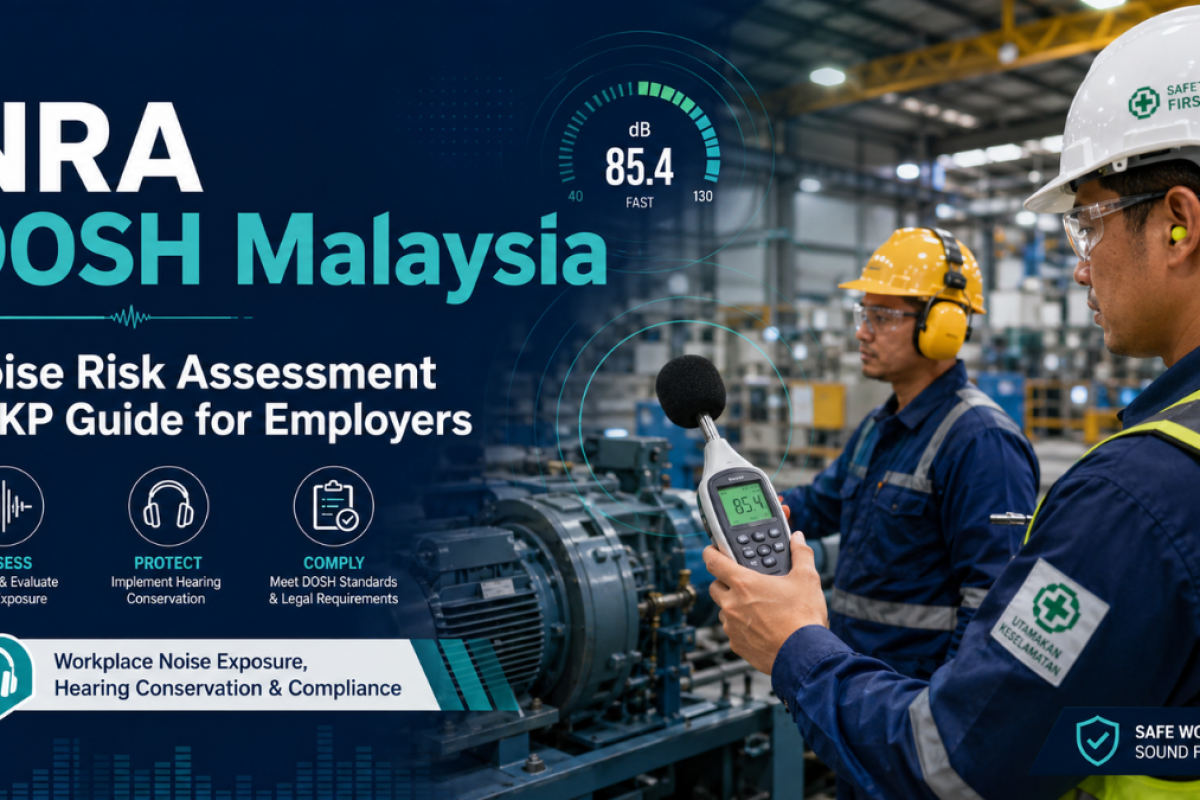
NRA DOSH refers to Noise Risk Assessment requirements under the Department of Occupational Safety and Health Malaysia, also known as JKKP.
In Malaysia, employers must assess and manage workplace noise exposure when employees may be exposed to excessive noise. A proper Noise Risk Assessment helps identify high-noise areas, evaluate worker exposure, recommend control measures and support hearing conservation planning.
NRA is especially important for workplaces using noisy machinery, compressors, generators, cutting tools, grinders, stamping machines, fabrication equipment, production lines, construction equipment or other high-noise processes.
Key Takeaways:
- NRA DOSH refers to Noise Risk Assessment requirements under DOSH Malaysia.
- JKKP is the Bahasa Malaysia name for DOSH.
- Excessive noise includes daily exposure above 82 dB(A), daily personal noise dose above 50%, maximum sound pressure level above 115 dB(A), or peak sound pressure level above 140 dB(C).
- Employers must ensure employees are not exposed above the legal exposure limits.
- NRA should be conducted by a competent Noise Risk Assessor using proper methods and calibrated equipment.
- A complete NRA should assess noise sources, worker exposure, exposure duration, Similar Exposure Groups and control measures.
- Employers should not rely only on earplugs; engineering and administrative controls should also be considered.
- NRA is closely linked to audiometric testing and hearing conservation.
- Records should be properly maintained for DOSH/JKKP inspection and internal audit.
- Advanced HSE Solutions can support NRA planning, workplace noise survey, noise mapping, control recommendations and compliance documentation.

What Is NRA DOSH?
NRA DOSH commonly refers to Noise Risk Assessment under Malaysia’s occupational safety and health framework.
The term NRA can also refer to a Noise Risk Assessor, which is the competent person who conducts the assessment.
This is why employers may see different terms being used, such as:
- NRA DOSH
- NRA JKKP
- Noise Risk Assessment DOSH
- Noise Risk Assessment JKKP
- Workplace noise assessment Malaysia
- Occupational noise assessment Malaysia
- Noise exposure assessment Malaysia
- Noise Risk Assessor Malaysia
For employers, the practical meaning is simple: if your workplace may expose employees to excessive noise, you need to assess the risk properly and take action to control it.
What Is JKKP?
JKKP stands for Jabatan Keselamatan dan Kesihatan Pekerjaan.
In English, JKKP is known as DOSH, the Department of Occupational Safety and Health Malaysia.
Therefore, NRA DOSH and NRA JKKP usually refer to the same topic: workplace noise risk assessment and compliance under Malaysia’s occupational safety and health requirements.
Why Noise Risk Assessment Matters
Workplace noise is a serious occupational health risk. It is not only about discomfort or communication difficulty.
Excessive noise exposure can contribute to:
- Noise-induced hearing loss
- Tinnitus or ringing in the ears
- Communication difficulty
- Reduced concentration
- Higher accident risk
- Fatigue and stress
- Reduced productivity
- Long-term occupational health claims
- Compliance and enforcement issues
Noise-related hearing damage is often gradual. By the time a worker notices hearing loss, the damage may already be permanent.
This is why employers should manage noise exposure proactively instead of waiting for complaints, abnormal audiometric results or a DOSH/JKKP inspection.
Legal Basis for NRA in Malaysia
Noise Risk Assessment in Malaysia is mainly governed by the Occupational Safety and Health (Noise Exposure) Regulations 2019.
The regulation requires employers to identify excessive noise, assess noise exposure, reduce exposure using appropriate controls, provide information and training, conduct audiometric testing where required and maintain proper records.
The regulation is supported by DOSH’s Industry Code of Practice for Management of Occupational Noise Exposure and Hearing Conservation 2019.
Employers should also refer to DOSH guidance on occupational noise-related hearing disorders and occupational noise control for practical implementation.
What Is Considered Excessive Noise?
Under Malaysia’s Noise Exposure Regulations, excessive noise is triggered when exposure exceeds any of the following:
- Daily noise exposure level exceeding 82 dB(A)
- Daily personal noise dose exceeding 50%
- Maximum sound pressure level exceeding 115 dB(A) at any time
- Peak sound pressure level exceeding 140 dB(C)
This means employers should not only look at average noise. Short-duration high noise, peak noise and personal exposure can also be important.
What Is the Noise Exposure Limit?
Employers must ensure employees are not exposed above the legal noise exposure limit.
The key exposure limits include:
- Daily noise exposure level exceeding 85 dB(A)
- Daily personal noise dose exceeding 100%
- Maximum sound pressure level exceeding 115 dB(A) at any time
- Peak sound pressure level exceeding 140 dB(C)
In practical terms, if employees are working around noisy equipment, machinery or processes, the employer should not assume that the workplace is compliant without proper assessment.
When Is NRA Required?
Noise Risk Assessment is required when excessive noise is identified or suspected at the workplace.
Common indicators include:
- Workers need to raise their voice to communicate
- Employees complain about loud noise
- Workers experience ringing ears after work
- There are abnormal audiometric test results
- Noisy machinery or tools are used
- Compressors, generators or blowers are operating
- Grinding, cutting, stamping, drilling or fabrication work is carried out
- Production lines create continuous noise
- Construction or demolition activity is involved
- Heavy vehicles or forklifts operate frequently
- Noise control measures are unclear or outdated
- DOSH/JKKP requests evidence of noise exposure management
If any of these apply, employers should review whether a Noise Risk Assessment is needed.
Which Industries Commonly Need NRA?
NRA is common in industries where workers are exposed to machinery, production equipment, mechanical processes or high-energy operations.
Examples include:
- Manufacturing
- Metal fabrication
- Food and beverage processing
- Packaging plants
- Automotive workshops
- Engineering workshops
- Construction sites
- Warehousing and logistics
- Printing plants
- Woodworking
- Quarrying
- Oil and gas support services
- Semiconductor and electronics manufacturing
- Maintenance and facilities operations
- Utilities and power generation areas
Even office-based companies may have noise exposure issues if they operate plant rooms, generator rooms, compressor areas, maintenance workshops or production support facilities.
Who Can Conduct NRA?
A proper Noise Risk Assessment should be conducted by a competent Noise Risk Assessor.
Employers should not rely on mobile phone apps, rough estimates or uncalibrated meters for compliance decisions.
A competent assessment should use appropriate measurement methods, calibrated equipment, proper exposure evaluation and a structured report with recommendations.
The assessor should be able to identify noise sources, assess exposure patterns, evaluate Similar Exposure Groups, interpret results and recommend practical control measures.
What Does a Noise Risk Assessment Include?
A complete NRA should be more than a simple noise reading.
A proper assessment may include:
- Workplace walkthrough
- Review of work process and machinery
- Identification of noisy areas
- Area noise measurement
- Personal noise exposure monitoring
- Noise mapping
- Identification of Similar Exposure Groups
- Review of work duration and exposure pattern
- Review of existing noise controls
- Review of hearing protection use
- Assessment of exposure against legal limits
- Recommendation of engineering controls
- Recommendation of administrative controls
- Recommendation of Personal Hearing Protectors
- Hearing conservation programme recommendations
- Reporting and documentation for compliance
The purpose is to help the employer understand where the noise risk is, who is exposed and what should be done next.
NRA Process for Employers
A practical NRA process normally includes the following stages.
Step 1: Identify Potential Noise Sources
The employer should identify machines, tools, activities and areas that may generate excessive noise.
Examples include compressors, generators, stamping machines, grinders, cutting machines, blowers, production lines, pumps, turbines, forklifts, power tools and construction equipment.
Step 2: Conduct Initial Noise Hazard Identification
Before full assessment, the employer or appointed competent person may conduct a basic noise hazard identification exercise.
This helps decide whether excessive noise is likely and whether further assessment is needed.
If the workplace shows signs of excessive noise, the employer should proceed with a proper Noise Risk Assessment.
Step 3: Appoint a Competent Noise Risk Assessor
The employer should engage a competent Noise Risk Assessor to conduct the assessment using appropriate methods and calibrated equipment.
This is important because the report may be used for DOSH/JKKP compliance, hearing conservation planning and audit records.
Step 4: Conduct Noise Measurement and Exposure Assessment
The assessor may conduct area monitoring, personal exposure monitoring or both, depending on the workplace and exposure pattern.
The assessment should consider:
- Noise source
- Worker location
- Duration of exposure
- Work rotation
- Shift pattern
- Similar Exposure Groups
- Existing controls
- Peak or intermittent noise
- Personal hearing protection
- Actual work activity
This helps determine whether workers are exposed above action levels or exposure limits.
Step 5: Analyse Results and Risk Level
The results should be compared with the legal criteria for excessive noise and noise exposure limits.
The report should clearly identify:
- High-noise areas
- Exposed workers or groups
- Exposure level
- Whether exposure exceeds legal limits
- Existing control gaps
- Required corrective actions
- Recommended monitoring or reassessment
The employer should not only file the report. The findings must be reviewed and acted upon.
Step 6: Implement Noise Control Measures
If excessive noise is identified, the employer should reduce exposure using proper controls.
Control measures should follow the hierarchy of control as far as practicable.
Engineering controls are usually preferred because they control noise at the source or along the transmission path.
Administrative controls and hearing protection may also be needed, especially where engineering controls cannot immediately reduce exposure sufficiently.
Step 7: Establish Hearing Conservation Measures
If employees are exposed to excessive noise, the employer may need to implement hearing conservation measures.
This may include:
- Audiometric testing
- Employee training
- Hearing protection selection
- Hearing protection supervision
- Noise warning signage
- High-noise area control
- Periodic review of noise exposure
- Medical follow-up where required
- Recordkeeping
A good hearing conservation programme helps detect early signs of hearing damage and ensures employees understand how to protect themselves.
Step 8: Reassess When Needed
Noise exposure should be reassessed when workplace conditions change.
Reassessment may be needed when:
- New machinery is installed
- Existing machinery is modified
- Production volume increases
- Work layout changes
- Work duration changes
- New work process is introduced
- Control measures are changed
- Audiometric results indicate possible concern
- DOSH/JKKP requests updated assessment
- Previous assessment is outdated
Employers should also maintain a review schedule to ensure noise risk data remains current.
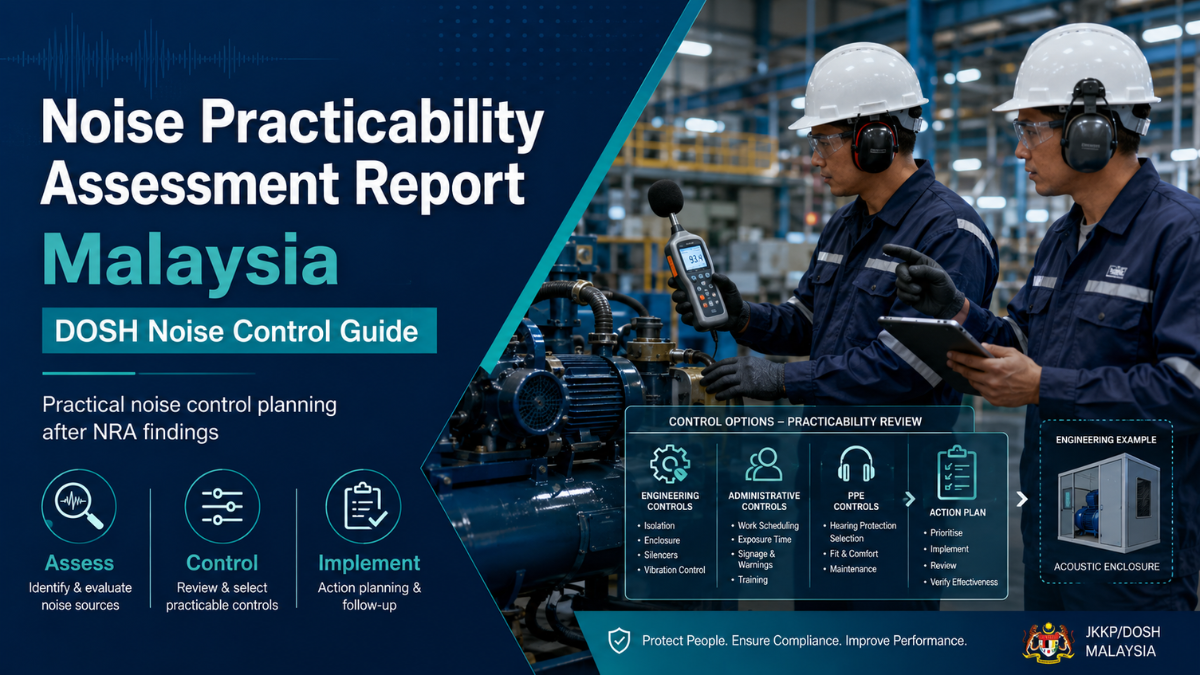
Noise Control Measures Employers Should Consider
Noise control should not depend only on earplugs.
Employers should first consider whether the noise can be reduced at the source or through workplace design.
Engineering Controls
Engineering controls may include:
- Replacing noisy machinery with quieter equipment
- Installing acoustic enclosures
- Installing noise barriers
- Using silencers or mufflers
- Reducing vibration
- Isolating noisy equipment
- Improving machine maintenance
- Lubricating moving parts
- Replacing worn bearings or belts
- Redesigning machine foundation
- Using damping materials
- Separating noisy operations from workers
Engineering controls are often more effective because they reduce exposure for everyone in the area.
Administrative Controls
Administrative controls may include:
- Reducing time spent in noisy areas
- Rotating workers where suitable
- Scheduling noisy tasks when fewer workers are present
- Restricting access to high-noise zones
- Marking hearing protection zones
- Displaying noise warning signage
- Improving maintenance schedules
- Planning quieter work methods
- Training supervisors and employees
Administrative controls are useful, but they must be managed properly to remain effective.
Personal Hearing Protection
Personal Hearing Protectors may include:
- Earplugs
- Earmuffs
- Canal caps
- Dual protection for very high-noise areas
Employers should ensure hearing protectors are suitable, correctly selected, properly worn and maintained.
Providing earplugs without training, fit checking or supervision is not enough.
NRA and Audiometric Testing
Noise Risk Assessment is closely linked to audiometric testing.
If workers are exposed to excessive noise, audiometric testing may be required to monitor hearing health.
Audiometric testing helps identify early signs of hearing deterioration and allows employers to review whether noise controls and hearing protection are effective.
Employers should keep audiometric records properly and take action when results indicate possible occupational noise-related hearing issues.
NRA and Hearing Conservation Programme
A Hearing Conservation Programme is a structured programme to prevent occupational hearing loss.
It may include:
- Noise Risk Assessment
- Noise control planning
- Hearing protection programme
- Audiometric testing
- Worker training
- Medical review where required
- Signage and access control
- Recordkeeping
- Reassessment and continuous improvement
NRA is usually the starting point because it identifies the noise risk and determines which workers or areas need further control.
Documents Employers Should Keep
Proper documentation is important for DOSH/JKKP inspection and internal audit.
Employers should keep:
- Noise Risk Assessment report
- Noise measurement results
- Noise maps
- Calibration certificates
- Similar Exposure Group records
- List of exposed workers
- Control measure records
- Hearing protection issue records
- Hearing protection training records
- Audiometric testing records
- Medical follow-up records, where applicable
- Corrective action records
- Review and reassessment records
- Contractor noise exposure records, where applicable
Good documentation shows that noise exposure is being managed systematically.
Common NRA Mistakes Employers Make
Many employers only act after a complaint, abnormal audiometric result or DOSH/JKKP inspection.
Common mistakes include:
- Assuming noise is acceptable without measurement
- Using phone apps instead of proper assessment
- Not appointing a competent Noise Risk Assessor
- Measuring only area noise but ignoring personal exposure
- Not identifying Similar Exposure Groups
- Not considering exposure duration
- Ignoring intermittent high-noise tasks
- Providing earplugs without training
- Not checking whether hearing protection is suitable
- Not maintaining noise control equipment
- Not arranging audiometric testing when required
- Not acting on NRA recommendations
- Not reassessing after machinery or process changes
- Keeping the report but not implementing corrective actions
The real value of NRA comes from the actions taken after the assessment.
How Employers Should Prepare Before NRA
Before conducting NRA, employers should prepare basic information and access.
Preparation may include:
- List of machinery and noisy equipment
- Workplace layout
- Production process flow
- Shift schedule
- Worker task list
- Maintenance schedule
- Existing noise control measures
- Existing hearing protection records
- Previous NRA report, if any
- Audiometric testing records, if any
- Details of complaints or hearing-related issues
- Access to high-noise areas
- Person in charge for site coordination
Good preparation helps the assessment run smoothly and improves report accuracy.
NRA Checklist for Employers
Use this checklist to prepare for Noise Risk Assessment.
Workplace Information
- Workplace layout prepared
- Process flow available
- Noisy machinery identified
- Shift pattern confirmed
- Worker tasks listed
- High-noise areas identified
Document Preparation
- Previous NRA report available, if any
- Machinery list available
- Maintenance records available
- Hearing protection records available
- Audiometric records available, if any
- Training records available
- Existing noise control records available
Site Readiness
- Access to noisy areas arranged
- Supervisors informed
- Workers briefed
- Equipment operating under normal conditions
- Safety access prepared
- Responsible person available
Post-Assessment Action
- Review report findings
- Identify affected workers
- Prioritise high-risk areas
- Plan engineering controls
- Plan administrative controls
- Review hearing protection
- Arrange training
- Arrange audiometric testing where required
- Track corrective actions
- Plan reassessment
How Advanced HSE Solutions Can Help
Advanced HSE Solutions supports Malaysian employers with Industrial Hygiene Assessment and Monitoring, including Noise Risk Assessment, workplace noise survey, high-noise area identification, worker exposure evaluation, noise mapping, control measure review, hearing conservation support, PPE recommendation, reporting and documentation.
For NRA DOSH / Noise Risk Assessment JKKP support, our team can assist with:
- Workplace noise risk assessment planning
- Noise survey and exposure evaluation
- High-noise area identification
- Noise mapping
- Similar Exposure Group review
- Control measure recommendations
- Hearing conservation support
- Personal Hearing Protector recommendations
- DOSH/JKKP documentation support
- Corrective action planning
- HSE compliance improvement
If your workplace uses noisy machinery, production lines, compressors, generators, fabrication equipment or construction equipment, it is advisable to review your workplace noise exposure before it becomes a compliance issue.
Conclusion
NRA DOSH, also known as Noise Risk Assessment JKKP, is an important part of occupational health compliance in Malaysia.
It helps employers identify excessive noise, assess worker exposure, implement control measures and protect employees from occupational hearing damage.
For employers, the key message is simple: do not assume noise exposure is acceptable without proper assessment. Conduct NRA when excessive noise is suspected, act on the findings, train employees, maintain records and review controls regularly.
A well-managed noise risk assessment process supports DOSH/JKKP compliance, protects workers’ hearing and creates a safer, more productive workplace.
FAQ
What is NRA DOSH?
NRA DOSH refers to Noise Risk Assessment requirements under the Department of Occupational Safety and Health Malaysia. It helps employers identify excessive workplace noise, assess employee exposure and recommend suitable control measures.
What is NRA JKKP?
NRA JKKP means the same thing as NRA DOSH. JKKP is Jabatan Keselamatan dan Kesihatan Pekerjaan, the Bahasa Malaysia name for DOSH.
When is Noise Risk Assessment required?
Noise Risk Assessment is required when excessive noise is identified or suspected at the workplace, such as when noisy machinery, compressors, generators, grinders, production lines or construction equipment may expose workers to harmful noise levels.
What is considered excessive noise in Malaysia?
Excessive noise includes daily noise exposure exceeding 82 dB(A), daily personal noise dose exceeding 50%, maximum sound pressure level exceeding 115 dB(A), or peak sound pressure level exceeding 140 dB(C).
What is the legal noise exposure limit in Malaysia?
Employers must ensure employees are not exposed above 85 dB(A) daily noise exposure level, 100% daily personal noise dose, 115 dB(A) maximum sound pressure level, or 140 dB(C) peak sound pressure level.
Who can conduct NRA?
NRA should be conducted by a competent Noise Risk Assessor using proper noise measurement methods and calibrated equipment.
What does an NRA report include?
An NRA report may include noise measurement results, high-noise area identification, worker exposure evaluation, Similar Exposure Groups, noise maps, control recommendations, hearing protection advice and hearing conservation recommendations.
Is audiometric testing required after NRA?
Audiometric testing may be required when employees are exposed to excessive noise. It helps monitor workers’ hearing health and supports the hearing conservation programme.
How often should Noise Risk Assessment be reviewed?
Noise Risk Assessment should be reviewed when workplace conditions change, such as new machinery, process changes, layout changes, increased production, new exposure patterns or when requested by DOSH/JKKP.
Can Advanced HSE Solutions help with NRA DOSH?
Yes. Advanced HSE Solutions can assist with Noise Risk Assessment planning, workplace noise survey, worker exposure evaluation, noise mapping, control measure recommendations, hearing conservation support and DOSH/JKKP documentation.