Table of Contents
Quick Answer: What Is Chemical Exposure Monitoring?
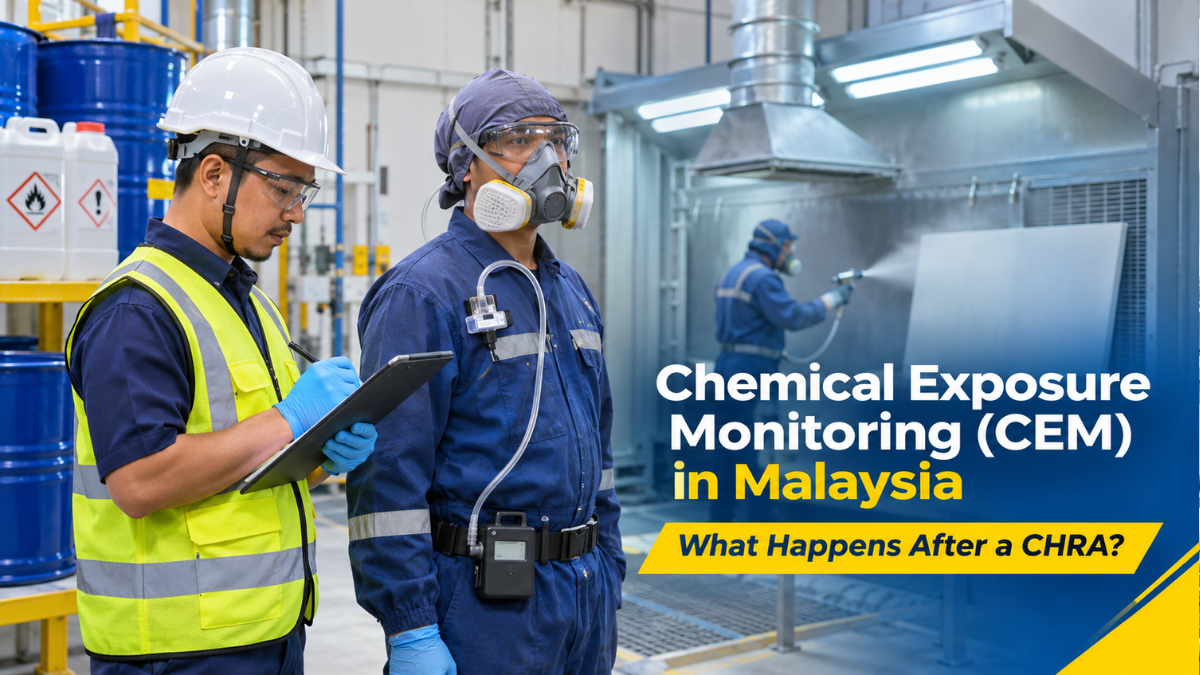
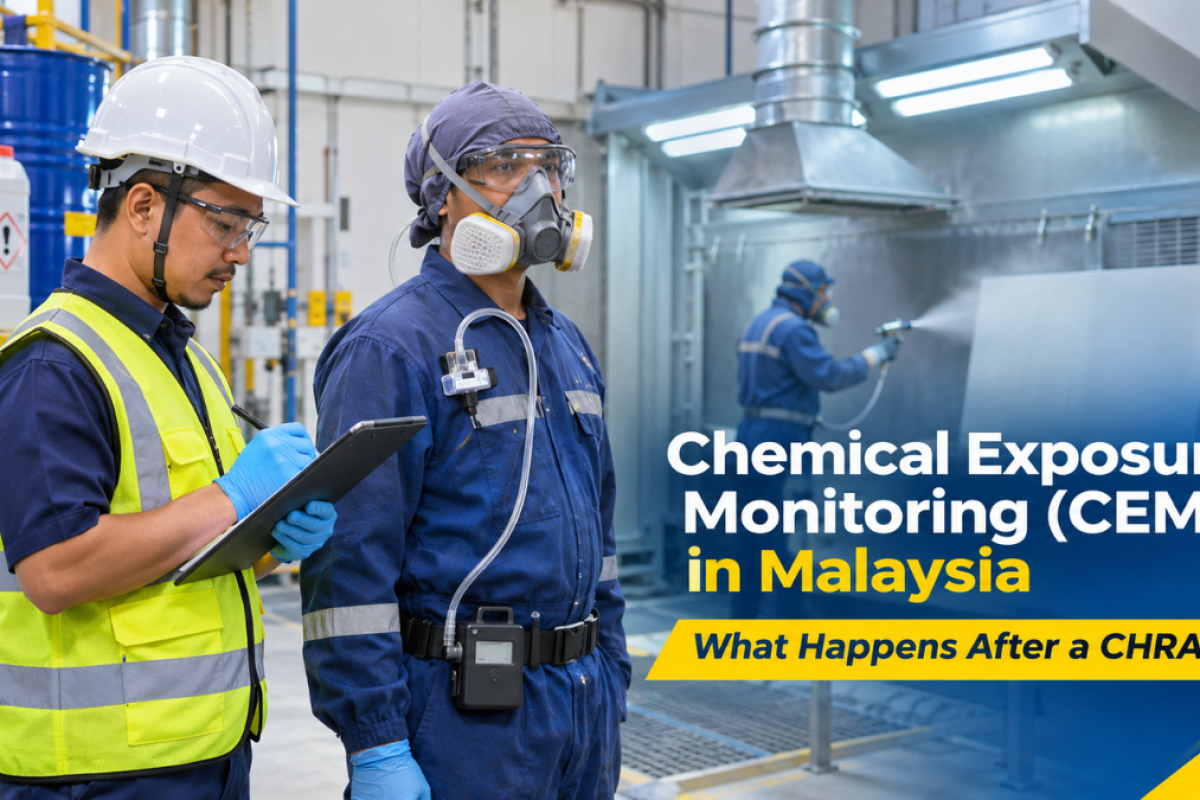
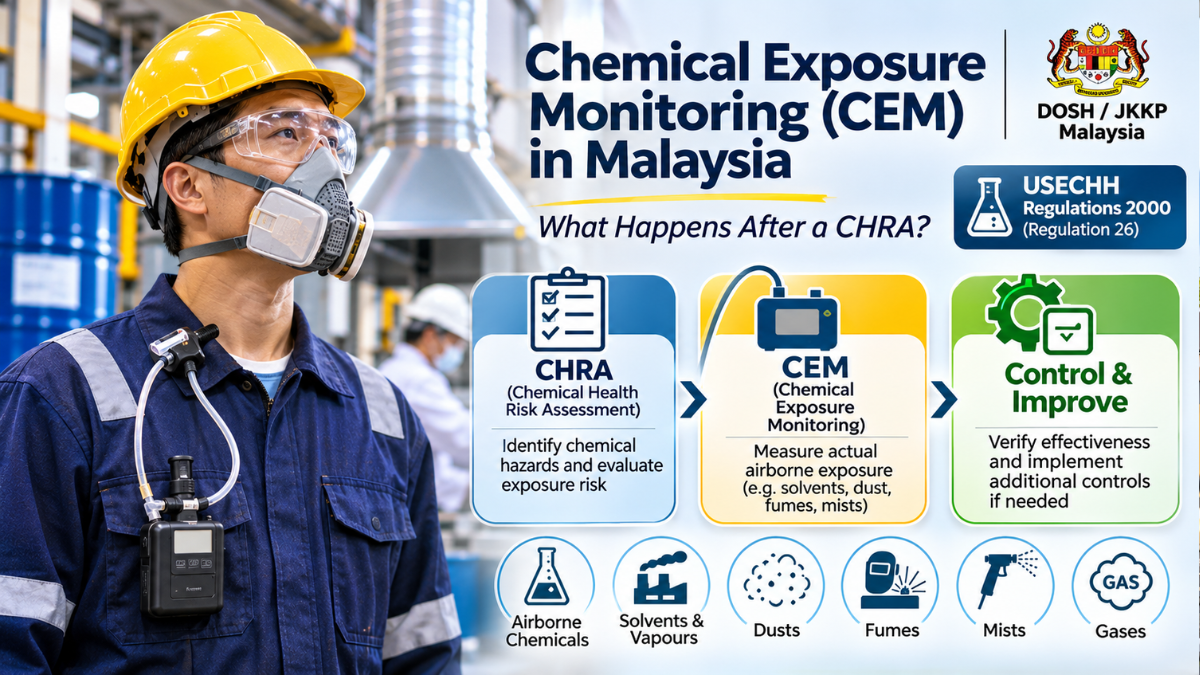
Chemical Exposure Monitoring (CEM) is the measurement of employees’ exposure to airborne chemicals hazardous to health at the workplace.
In Malaysia, CEM is required under the Occupational Safety and Health (Use and Standards of Exposure of Chemicals Hazardous to Health) Regulations 2000, commonly known as the USECHH Regulations 2000, when a Chemical Health Risk Assessment (CHRA) indicates that monitoring is necessary or when monitoring is required to ensure that existing exposure controls remain effective.
CEM helps employers determine the concentration of chemicals workers may inhale and evaluate the results against applicable Permissible Exposure Limits (PELs).
Under USECHH Regulation 26, chemical exposure monitoring must generally be conducted by a hygiene technician. For formal chemical exposure monitoring, employers should appoint a DOSH-registered Hygiene Technician 1 (HT1).
The results help employers decide whether existing controls are adequate, additional improvements are needed, or further monitoring is required.
Key Takeaways:
Chemical Exposure Monitoring measures employees’ exposure to airborne chemicals hazardous to health.
CEM is required when CHRA recommends monitoring or when it is necessary to verify effective exposure control.
USECHH Regulation 26 governs occupational chemical exposure monitoring in Malaysia.
CEM should generally be conducted by a DOSH-registered Hygiene Technician 1.
Personal exposure monitoring is important when comparing worker exposure against PELs.
Monitoring results must be interpreted using the applicable exposure limits and sampling conditions.
For Schedule II chemicals, Regulation 26 sets specific periodic monitoring requirements.
Employers must take appropriate action where chemical exposure exceeds permissible limits.
Personal exposure records must be kept for at least 30 years, while other monitoring records have a minimum five-year retention period.
Advanced HSE Solutions can support CEM planning, monitoring coordination, reporting, corrective action and chemical safety training.
What Is Chemical Exposure Monitoring (CEM)?
Chemical Exposure Monitoring is an occupational hygiene assessment used to measure airborne chemical contaminants to which employees may be exposed during work.
It is also known as:
CEM DOSH
CEM JKKP
Chemical exposure assessment
Airborne chemical monitoring
Workplace chemical air monitoring
Personal exposure monitoring
Occupational chemical exposure monitoring
CEM commonly evaluates airborne contaminants such as solvents, vapours, gases, dusts, fumes, fibres and mists generated during industrial or commercial work processes.
Unlike a general air quality inspection, CEM is specifically designed to assess occupational exposure associated with workplace activities.
For example, a worker using a solvent for cleaning may inhale vapour during handling, application and evaporation. Chemical Exposure Monitoring can help quantify that inhalation exposure.
Why Is CEM Important After CHRA?
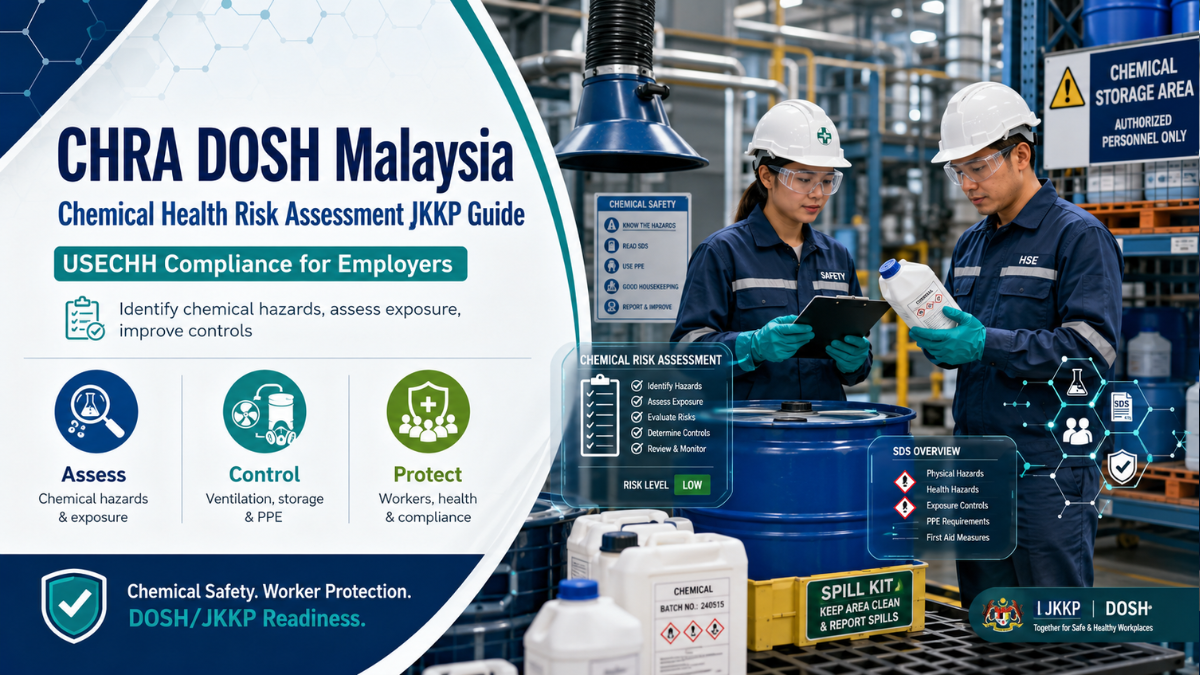
A Chemical Health Risk Assessment (CHRA) identifies chemical hazards, assesses the potential for worker exposure and evaluates the adequacy of existing control measures.
However, CHRA does not necessarily measure the concentration of chemicals that employees actually inhale.
When the CHRA assessor identifies uncertainty about airborne exposure or recommends monitoring, CEM provides quantitative exposure information.
The relationship is straightforward:
CHRA identifies and evaluates chemical health risks. CEM measures airborne exposure. The employer then uses the results to verify and improve controls.
For example, a CHRA at a manufacturing facility may identify solvent handling as a potential inhalation hazard.
The report may recommend Chemical Exposure Monitoring to determine whether workers are adequately protected by the existing Local Exhaust Ventilation (LEV) system and safe work procedures.
The monitoring results provide evidence to support the next management decision.
Legal Requirements for CEM in Malaysia
Chemical Exposure Monitoring is primarily governed by the USECHH Regulations 2000.
Regulation 26: Monitoring of Exposure
Under Regulation 26(1), employers must ensure exposure monitoring is conducted when:
A health risk assessment indicates that exposure monitoring is required; or
Monitoring is necessary to ensure the continued adequacy of measures used to control workers’ chemical exposure.
Monitoring must follow an approved method of monitoring and analysis.
Regulation 26(3): Competent Personnel
Chemical Exposure Monitoring must generally be conducted by a hygiene technician.
DOSH identifies Hygiene Technician 1 (HT1) as the competent-person category responsible for conducting Chemical Exposure Monitoring.
The specific exception in Regulation 26(3) concerns certain confined-space pre-entry checks for toxic or flammable gases and oxygen levels.
Employers should verify the relevant DOSH competency registration before appointing a monitoring provider.
Regulation 26(4): Recordkeeping
Employers must maintain monitoring records for the required retention periods.
Records representative of personal chemical exposure must be kept for at least 30 years, while other monitoring records must be kept for at least five years.
When Is Chemical Exposure Monitoring Required?
CEM should be arranged when the CHRA recommends it or when it is needed to confirm that chemical exposure controls are adequate.
Common situations include:
CHRA identifies possible airborne chemical exposure
Workers handle solvents, powders or chemicals capable of becoming airborne
Employees perform spraying, mixing, cleaning or chemical transfer
A process generates welding fumes, dust or chemical mist
Existing ventilation effectiveness is uncertain
Engineering controls have been modified
A new chemical or production process is introduced
Employees report symptoms potentially associated with exposure
Previous monitoring results indicate elevated exposure
DOSH/JKKP requests appropriate exposure monitoring evidence
Not every chemical used at a workplace automatically requires air sampling.
The requirement depends on the chemical hazard, work process, exposure potential, CHRA findings and applicable legal provisions.
CHRA vs CEM: What Is the Difference?
Although both are important parts of workplace chemical management, they serve different purposes.
| Element | CHRA | CEM |
|---|---|---|
| Full name | Chemical Health Risk Assessment | Chemical Exposure Monitoring |
| Primary objective | Evaluate chemical health risks | Measure airborne exposure |
| Main activity | Review hazards, tasks, exposures and controls | Collect and analyse air samples |
| Competent person | DOSH-registered CHRA assessor | DOSH-registered Hygiene Technician 1 |
| Main output | Chemical health risk assessment report | Chemical exposure monitoring report |
| Key decision | What risks and controls need attention? | How much airborne exposure is occurring, and how does it compare with relevant limits? |
CHRA and CEM are complementary.
A completed CHRA does not remove the requirement to conduct CEM when monitoring is recommended or otherwise necessary under Regulation 26.
Similarly, a CEM report does not replace a formal CHRA.
What Chemicals Can Be Monitored?
The chemicals selected for monitoring depend on the workplace’s chemical inventory, Safety Data Sheets, CHRA recommendations and work processes.
Common examples include:
Organic Solvents
Toluene
Xylene
Acetone
Methyl ethyl ketone
Other solvent vapours
Metal Fumes and Dusts
Welding fumes
Metal-containing particulates
Dust generated during grinding
Respirable dust from machining or processing
Industrial Chemicals
Ammonia
Formaldehyde
Acid mists
Process-generated chemical vapours
Other Airborne Contaminants
Silica-containing respirable dust
Oil mist
Paint spray mist
Selected fibres
Chemicals released during mixing, transfer or maintenance
The sample collection and analytical methods should be selected for the specific contaminant and exposure objective.
A general-purpose air quality meter cannot automatically replace a suitable chemical-specific sampling method.
How Chemical Exposure Monitoring Is Conducted
DOSH’s Guidelines on Monitoring of Airborne Chemical Hazardous to Health 2022 describe a structured monitoring procedure.
Step 1: Review the CHRA Report
The monitoring process should begin with the existing CHRA.
The Hygiene Technician 1 reviews:
Chemicals recommended for monitoring
Work units and affected employees
Potential exposure routes
Work activities and duration
Existing engineering controls
Existing monitoring results, where available
Relevant permissible exposure limits
This ensures monitoring is targeted at the identified chemical hazards rather than performed as a generic air quality survey.
Step 2: Conduct a Preliminary Workplace Survey
The hygiene technician reviews the workplace layout, processes and operating conditions.
This may involve observing actual chemical handling activities, understanding worker movements and confirming when exposure is likely to be highest.
The preliminary survey helps determine suitable monitoring locations, worker groups and sampling methods.
Step 3: Identify Similar Exposure Groups
A Similar Exposure Group (SEG) consists of workers who are expected to experience similar chemical exposure because they perform comparable tasks under similar conditions.
For example, workers carrying out the same solvent cleaning activity may belong to one SEG.
Other SEGs may include spray painters, mixing operators, production workers or maintenance personnel.
SEG identification is important because exposure varies between jobs, tasks and operating conditions.
Step 4: Select the Sampling Method
The selected method depends on the chemical’s physical form and the exposure objective.
Sampling may involve:
Personal air sampling pumps
Sorbent tubes
Filter-based sampling media
Passive sampling devices
Direct-reading instruments
Other suitable validated monitoring methods
The hygiene technician should use appropriate recognised methods and document the equipment, sampling conditions and quality-control arrangements.
Step 5: Conduct Personal or Area Sampling
There are two main types of monitoring.
Personal Exposure Monitoring
Personal sampling equipment is worn by the employee, with the sampling inlet positioned within the breathing zone.
This is particularly important for evaluating inhalation exposure against occupational exposure limits.
Area Monitoring
Area sampling measures airborne chemical concentrations at selected workplace locations.
It may help identify contamination sources, assess ventilation performance or evaluate the effect of control measures.
However, area monitoring does not normally represent an employee’s personal exposure and should not automatically be used to demonstrate compliance with personal exposure limits.
Step 6: Determine Sampling Duration
Sampling duration depends on the exposure limit and monitoring objective.
For example, an eight-hour Time-Weighted Average exposure assessment requires an appropriate sampling strategy representing the relevant work shift.
Short-duration measurements may be necessary to evaluate peak exposures, maximum exposure limits or ceiling limits.
If sampling covers only part of a shift, the hygiene technician must consider the exposure during unsampled periods and document the assumptions used.
Step 7: Analyse Samples
Collected samples may be sent to a suitably accredited laboratory for analysis using the relevant method.
DOSH’s 2022 guideline specifies a laboratory accredited under the Skim Akreditasi Makmal Malaysia (SAMM) or an equivalent recognised international accreditation system.
Depending on the contaminant, laboratory analysis can determine the amount of chemical collected.
The hygiene technician then uses sampling volume, duration, analytical results and relevant corrections to determine airborne exposure concentrations.
Step 8: Compare Results With Exposure Limits
Monitoring results are evaluated against the applicable Permissible Exposure Limit or other relevant occupational exposure standard.
The hygiene technician should consider:
Exposure duration
Chemical-specific limits
Sampling uncertainty
Similar Exposure Group variability
Extended working hours where applicable
Short-term and ceiling exposure criteria
Combined exposure to multiple chemicals, where relevant
Step 9: Prepare the Monitoring Report
The findings should be documented in a formal Chemical Exposure Monitoring Report.
The report should explain the methodology, exposure results, applicable limits, interpretation, uncertainties and recommended follow-up actions.
DOSH’s 2022 guideline states that the hygiene technician’s report should be presented to the employer within one month after monitoring is completed.
Understanding Chemical Exposure Limits
One of the most important parts of CEM is interpreting the results correctly.
What Is a Permissible Exposure Limit?
A Permissible Exposure Limit, or PEL, is a regulatory airborne exposure criterion for a specified chemical.
Under Malaysia’s USECHH Regulations, Schedule I contains relevant exposure limits for listed chemicals.
The applicable limit may include an eight-hour Time-Weighted Average, a ceiling limit or a maximum exposure limit.
What Is an Eight-Hour TWA?
TWA means Time-Weighted Average.
An eight-hour TWA represents average chemical exposure over an eight-hour reference period.
The general calculation is:
8-hour TWA = Sum of (Concentration × Exposure Duration) ÷ 8 hours
For example, a worker may experience varying solvent concentrations while performing cleaning, mixing and inspection tasks.
The TWA calculation accounts for the concentration and duration of each exposure period.
Partial-shift data must be handled carefully to avoid incorrect assumptions about the unmeasured periods.
What Is a Ceiling Limit?
A ceiling limit is an airborne chemical concentration that must not be exceeded during any part of the workday.
It is different from an eight-hour TWA because averaging over a full shift cannot justify exceeding a ceiling limit.
What Is a Maximum Exposure Limit?
Under the USECHH Regulations, the maximum exposure limit relates to a 15-minute Time-Weighted Average concentration defined in relation to the relevant eight-hour exposure limit.
It is important to evaluate both longer-duration and short-duration exposure when the applicable criteria require this.
What Is the Action Level in Chemical Exposure Monitoring?
DOSH’s 2022 monitoring guideline defines the Action Level as 50% of the eight-hour TWA exposure limit.
The Action Level provides a screening benchmark for identifying exposure that warrants closer attention.
For example, where a chemical has an eight-hour PEL of 50 ppm, the corresponding Action Level is 25 ppm.
The Action Level is not the same as the legal PEL.
Exposure above the Action Level but below the PEL may still require periodic monitoring and additional review of the adequacy of controls.
Employers should also recognise that a single result below the PEL does not necessarily prove that all future exposures will remain compliant.
How Often Must CEM Be Repeated?
Monitoring frequency depends on the chemical, applicable regulation, monitoring results and assessor’s recommendations.
Under Regulation 26(2), where monitoring is required for chemicals listed in Schedule II, monitoring must be repeated at intervals of no more than six months, or sooner if determined by the assessor, until the assessor is satisfied that further monitoring is unnecessary.
DOSH’s 2022 guideline also provides risk-based follow-up recommendations. These include monitoring intervals of no more than 12 months for relevant exposures at or above half the eight-hour PEL but below the PEL, and no more than six months where exposure is at or above the PEL.
Discontinuing periodic monitoring must be supported by appropriate results and the applicable assessment requirements. It should not be decided solely because one sample is below the exposure limit.
What Happens if CEM Results Exceed the Exposure Limit?
An exposure above the applicable PEL indicates that existing controls may be inadequate and requires prompt employer action.
The response should be based on the chemical hazard, exposure magnitude, affected workers and competent professional advice.
1. Review the Immediate Exposure Risk
The employer should determine whether employees can continue the affected task safely.
Depending on the circumstances, temporary restrictions, alternative work methods or suspension of the affected operation may be necessary until suitable controls are established.
2. Identify Why Exposure Is Excessive
Possible causes include:
Inadequate Local Exhaust Ventilation
Poor ventilation capture effectiveness
Leaking equipment
Open chemical transfer
High solvent evaporation
Inappropriate chemical handling procedures
Increased production volume
Poor maintenance
Uncontrolled dust generation
Inadequate exposure controls during cleaning or maintenance
3. Implement Engineering and Process Controls
Employers should prioritise practical controls that reduce chemical exposure at source.
Examples include substitution, process enclosure, improved LEV, automated transfer, equipment repair or isolation of contaminated activities.
4. Strengthen Safe Work Procedures and Training
The employer should review chemical handling procedures, exposure duration, worker behaviour, supervision and relevant protective equipment.
Employees should understand the monitoring findings and the precautions required.
5. Review Health Surveillance Requirements
Where the CHRA identifies a need for health surveillance, the employer should arrange the appropriate programme.
Medical surveillance, when required, should be conducted by a DOSH-registered Occupational Health Doctor.
6. Conduct Follow-Up Monitoring
Once corrective controls have been implemented, further monitoring may be necessary to verify that exposure has been reduced to an acceptable level.
The monitoring schedule should comply with the applicable USECHH requirements and competent assessor’s recommendations.
7. Maintain Corrective Action Records
Employers should document the exposure findings, decisions, actions taken, responsible persons, completion dates and follow-up verification.
A monitoring report should lead to actual risk reduction—not simply be filed for a future inspection.
Can Exposure Be Considered Safe if Results Are Below the PEL?
Not automatically.
A result below the PEL is useful information, but it must be interpreted in the context of sampling representativeness, exposure variability, other chemicals present and the relevant health risks.
For example, employees may be exposed to two solvents with similar toxicological effects.
Even if each chemical is individually below its PEL, their combined exposure may still be excessive.
The DOSH 2022 guideline includes methods for evaluating combined exposure to chemicals with additive effects.
The monitoring assessment should therefore consider the complete exposure situation rather than relying on a single number.
CEM and Local Exhaust Ventilation
Local Exhaust Ventilation (LEV) is commonly used to capture chemical vapours, fumes, dusts or mists before they enter the worker’s breathing zone.
CEM can help evaluate whether employees remain adequately protected during actual work operations.
For example, a paint spraying facility may have an extraction system, but personal exposure measurements may reveal that workers are still exposed to elevated solvent vapour.
This can indicate the need to review airflow, capture position, enclosure design, maintenance or operating procedures.
CEM and LEV assessment serve different purposes but can provide complementary evidence for exposure control.
CEM and Chemical Handling Training
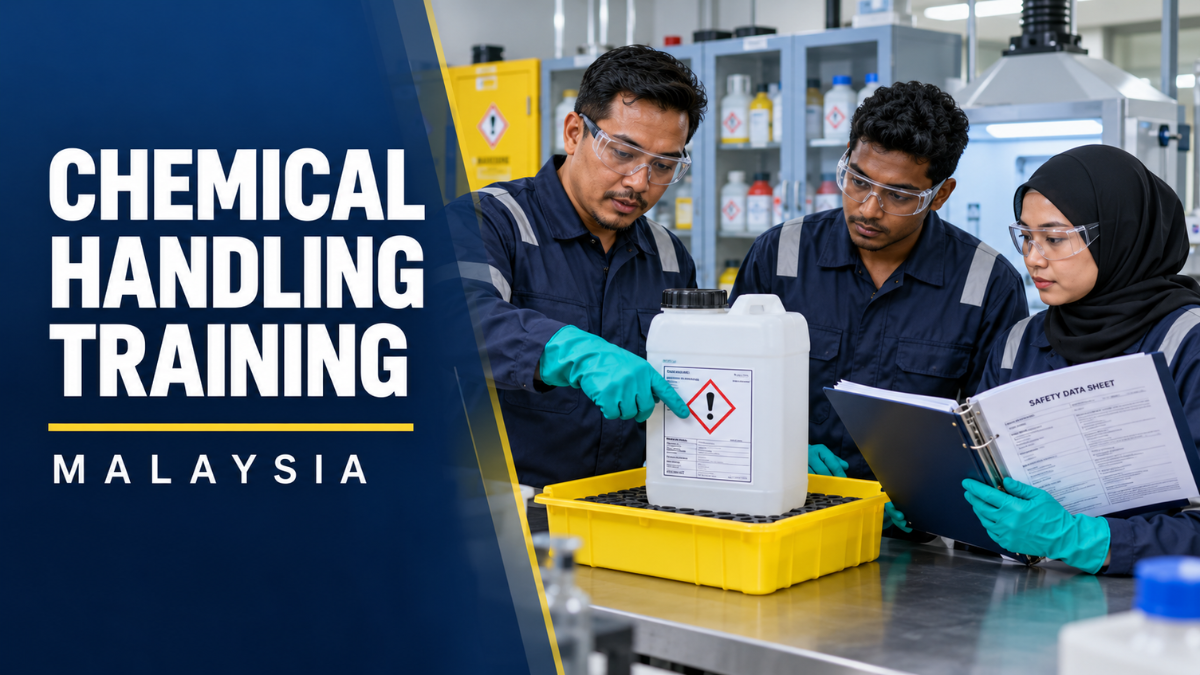
Chemical Handling Training should be part of the employer’s exposure management programme.
Training helps employees understand:
Chemical health hazards
Relevant monitoring findings
Safety Data Sheets
Inhalation exposure risks
Safe handling and storage
Suitable PPE and respirator use
Engineering control limitations
Spill response and emergency procedures
Reporting of symptoms and unsafe conditions
Under USECHH Regulation 22, employers must provide necessary chemical safety information, instruction and training, including information about workplace exposure monitoring results.
The regulation also requires training programmes to be reviewed and conducted at least once every two years, and when relevant hazard information, work practices, controls or assigned tasks change.
Training should be adapted to the actual chemicals and processes used by employees.
What Should a CEM Report Include?
A professional Chemical Exposure Monitoring Report should provide a clear record of the assessment and support informed employer decisions.
Typical content includes:
Company and workplace details
Monitoring objective
Reference to CHRA findings
Chemicals monitored
Work areas and processes
Similar Exposure Groups
Number of workers monitored
Sampling date and duration
Personal or area monitoring classification
Sampling methods
Equipment identification and calibration
Laboratory analysis information
Exposure calculations
Relevant PELs and other exposure criteria
Results and statistical evaluation
Discussion of existing controls
Limitations and uncertainties
Exposure control recommendations
Required monitoring frequency
Conclusion and supporting appendices
The report should clearly distinguish measured concentrations from interpretations and recommendations.
What Documents Should Employers Prepare Before CEM?
Before arranging monitoring, employers should prepare the relevant workplace information.
This may include:
Latest CHRA report
Register of Chemicals Hazardous to Health
Current Safety Data Sheets
Process flowchart
Workplace layout
List of employees and job tasks
Shift patterns and working hours
Chemical usage information
Existing LEV records
Relevant PPE and respirator arrangements
Previous CEM reports
Chemical handling SOPs
Exposure complaints or incident records
Previous corrective action records
This information helps the hygiene technician design a monitoring strategy that reflects actual exposure conditions.
Common Mistakes Employers Make After CHRA
Common mistakes include:
Ignoring CEM recommendations in the CHRA report
Assuming a CHRA is a substitute for air monitoring
Engaging personnel without the relevant DOSH competency
Using area sampling alone to claim personal exposure compliance
Monitoring during an unrepresentative low-production period
Not considering short-duration chemical exposure
Comparing results with the wrong limit or units
Ignoring exposure from mixed chemicals
Treating one below-limit result as permanent proof of compliance
Failing to review ventilation after excessive results
Not communicating results to employees
Not arranging periodic monitoring where required
Failing to retain monitoring records for the statutory period
A properly managed CEM programme should link assessment findings, actual exposure measurements, control improvements and follow-up verification.
Which Industries Commonly Need CEM?
Chemical Exposure Monitoring may be required in workplaces including:
Chemical manufacturing
Semiconductor and electronics manufacturing
Metal fabrication
Welding operations
Spray painting and coating
Printing
Pharmaceutical and laboratory operations
Automotive manufacturing
Food processing operations using hazardous chemicals
Cleaning and degreasing
Chemical storage and transfer
Industrial maintenance
Waste treatment
Water treatment
Other operations involving airborne chemicals hazardous to health
The need for monitoring should be determined from actual exposure risk and the relevant CHRA findings.
How Advanced HSE Solutions Can Help
Advanced HSE Solutions provides Industrial Hygiene Assessment & Monitoring support to Malaysian employers managing workplace chemical exposure.
Our Chemical Exposure Monitoring support may include:
-
Review of CHRA monitoring recommendations
-
Chemical exposure monitoring planning
-
Coordination with DOSH-registered Hygiene Technician 1 personnel
-
Personal exposure sampling
-
Area monitoring
-
Review of chemical handling processes
-
Exposure limit evaluation
-
Ventilation and exposure control review
-
Chemical exposure reporting
-
Corrective action planning
-
Coordination of follow-up monitoring
-
Chemical Handling Training support
-
DOSH/JKKP compliance documentation
Whether your workplace involves chemical mixing, solvent cleaning, spray painting, welding fumes, industrial dusts or process vapours, Advanced HSE Solutions can help you review the monitoring requirements and plan appropriate next steps.
Conclusion
Chemical Exposure Monitoring is a critical step after Chemical Health Risk Assessment when airborne exposure measurement is required.
CHRA identifies health risks and the need for further assessment. CEM provides measured exposure information to help determine whether existing controls are adequate.
For Malaysian employers, compliance does not end when the CEM report is received. Exposure results must be interpreted correctly, excessive exposures must be controlled, employees must receive appropriate information and training, and follow-up monitoring must be conducted where required.
The goal of CEM is not merely to produce an exposure report. It is to provide evidence that helps employers protect their employees from hazardous chemical exposure.
FAQ
What is Chemical Exposure Monitoring?
Chemical Exposure Monitoring is the measurement of airborne chemical exposure experienced by employees at work. It helps evaluate exposure against relevant occupational exposure limits.
Is CEM required after CHRA?
CEM is required when CHRA identifies monitoring as necessary or where monitoring is required to verify the adequacy of exposure controls under USECHH Regulation 26.
Who can conduct CEM in Malaysia?
Formal CEM must generally be conducted by a hygiene technician. DOSH recognises Hygiene Technician 1 as the competent-person category for chemical exposure monitoring.
What is the difference between CHRA and CEM?
CHRA assesses chemical health risks and identifies required controls. CEM measures airborne chemical exposure to evaluate the actual exposure conditions.
Is personal air sampling better than area sampling?
Personal air sampling is normally more suitable for assessing individual inhalation exposure against PELs. Area sampling is useful for identifying emission sources and assessing workplace conditions but generally does not replace personal sampling.
What is the chemical exposure limit in Malaysia?
Different chemicals have different permissible exposure limits. The applicable value should be checked against USECHH Schedule I and the relevant exposure criteria.
What happens when CEM results exceed the PEL?
The employer should promptly review and improve exposure controls, protect affected employees, investigate the cause of excessive exposure and arrange appropriate follow-up monitoring.
How often must CEM be repeated?
Frequency depends on the chemical, monitoring results and assessment requirements. USECHH Regulation 26 sets a six-month maximum interval for applicable Schedule II monitoring, while DOSH’s monitoring guidelines provide additional risk-based recommendations.
How long must CEM records be kept?
Records representative of personal chemical exposure must be retained for at least 30 years. Other monitoring records must be kept for at least five years under USECHH Regulation 26(4).
Can Advanced HSE Solutions help with CEM?
Yes. Advanced HSE Solutions supports Chemical Exposure Monitoring planning, personal and area sampling coordination, monitoring reports, exposure control recommendations and related compliance documentation.