Table of Contents
Quick Answer: What Is Heat Stress Assessment?
Heat Stress Assessment in Malaysia is the process of identifying, measuring and controlling workplace heat exposure that may endanger employees’ health and safety.
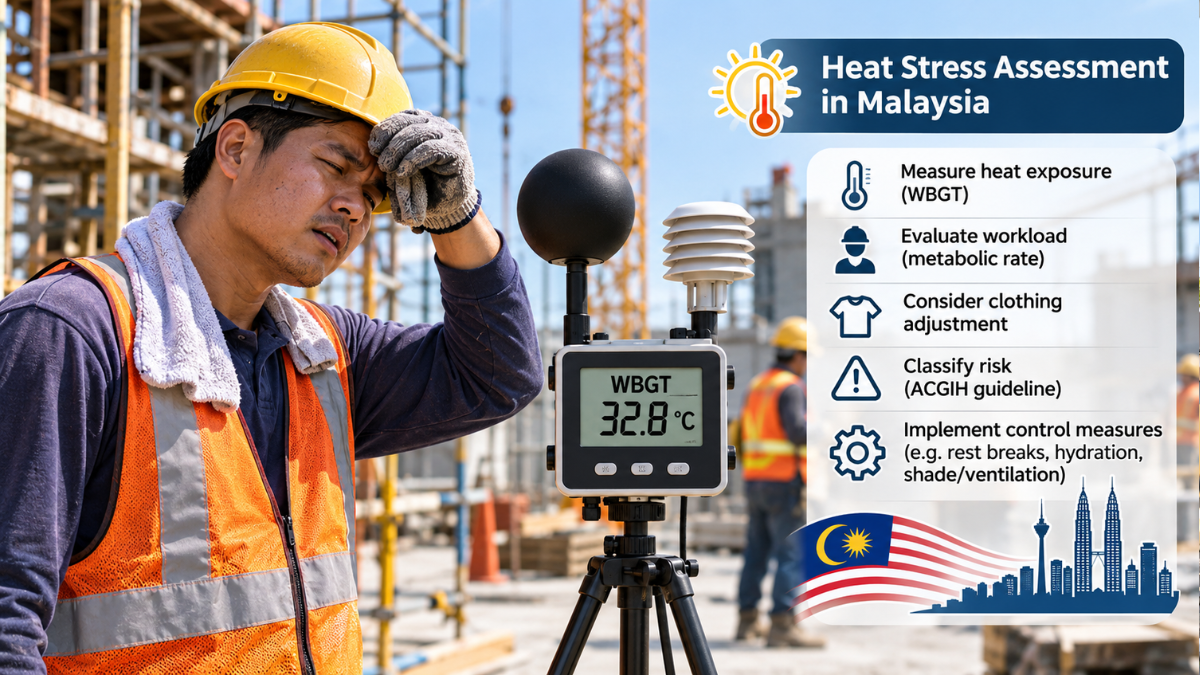
The Department of Occupational Safety and Health Malaysia (DOSH/JKKP) provides guidance under its Guidelines on Heat Stress Management at Workplace 2016. The assessment process includes initial heat hazard screening, Wet Bulb Globe Temperature (WBGT) measurement, workload evaluation, clothing adjustments, risk classification and appropriate control measures.
Employers should assess heat exposure wherever workers may face excessive environmental heat, radiant heat, high humidity or physically demanding work in hot conditions.
Heat stress assessment applies to outdoor activities such as construction and maintenance, as well as indoor operations including manufacturing, foundries, boiler rooms, industrial kitchens and poorly ventilated production areas.
Key Takeaways:
Heat Stress Assessment helps employers identify and control workplace heat exposure.
DOSH provides technical guidance through its 2016 Heat Stress Management Guidelines.
WBGT is more suitable for occupational heat assessment than ordinary air temperature alone.
WBGT monitoring should be linked to actual employee exposure conditions.
Workload, protective clothing, acclimatisation and work-rest schedules influence heat risk.
ACGIH Action Limits and TLVs are technical screening benchmarks, not universal Malaysian statutory heat limits.
High-risk exposure requires timely job-specific controls and appropriate escalation.
Employers should maintain assessment, calibration, training and corrective action records.
Heat stress risks should be included in workplace HIRARC and reviewed when conditions change.
Advanced HSE Solutions can support workplace heat stress assessment planning, monitoring coordination and practical risk management.
What Is Heat Stress at the Workplace?
Heat stress occurs when environmental conditions, physical activity and other factors create a heat load that makes it difficult for the body to maintain a safe internal temperature.
The human body generates heat during physical work and gains or loses heat through its surroundings. When heat gain exceeds the body’s ability to release heat, the risk of heat-related illness increases.
Important contributing factors include:
High air temperature
High relative humidity
Radiant heat from the sun, furnaces, ovens or machinery
Insufficient air movement
Heavy physical workload
Inadequate rest and recovery
Limited access to drinking water
Protective clothing that restricts heat loss
Insufficient heat acclimatisation
Heat stress is not simply a matter of whether the workplace feels hot. Employees performing demanding tasks may experience significant physiological heat strain even when the air temperature does not appear extreme.
Why Heat Stress Assessment Matters in Malaysia
Malaysia’s tropical climate exposes workers to warm and humid conditions throughout much of the year.
Extreme hot-weather episodes can further increase occupational risk. In April 2026, several districts in Peninsular Malaysia experienced Level 1 hot-weather alerts, with daily maximum temperatures reaching 35°C to 37°C for at least three consecutive days.
These weather warnings highlight the importance of workplace heat management. However, they do not replace an occupational heat stress assessment.
A weather station records regional conditions. A worker may experience substantially different conditions because of direct solar exposure, protective clothing, physical workload or heat-generating machinery.
A proper assessment helps employers determine whether workers are exposed to excessive heat and what protective measures are needed.
DOSH Heat Stress Guidelines Malaysia
The main technical reference for occupational heat stress management is the DOSH Guidelines on Heat Stress Management at Workplace 2016.
The guidelines provide a structured approach covering:
Recognition of workplace heat hazards
Preliminary heat stress screening
WBGT measurement
Clothing adjustment factors
Metabolic workload assessment
Work-rest regime evaluation
Comparison with ACGIH Action Limits and Threshold Limit Values
Risk classification
Control measures
Monitoring, training and documentation
The guidelines refer to international occupational hygiene principles, including ISO standards and ACGIH heat stress benchmarks.
Employers can consult the official DOSH Guidelines on Heat Stress Management at Workplace 2016.
Is Heat Stress Assessment Mandatory in Malaysia?
Malaysia does not currently have a single domestically legislated numerical WBGT exposure limit that applies universally to all workplaces.
However, employers remain responsible for assessing and controlling occupational safety and health risks under the Occupational Safety and Health Act 1994 (Act 514), as amended.
Two important provisions are:
Section 15 — General duties of employers
Employers must ensure, so far as is practicable, the safety, health and welfare of employees at work, including maintaining a working environment without risks to health.
Section 18B — Duty to conduct risk assessment
Employers, self-employed persons and principals must conduct risk assessments for safety and health risks arising from their undertakings. Where risk controls are required, appropriate controls must be implemented.
For applicable factory premises, relevant subsidiary safety, health and welfare provisions concerning excessive heat may also apply.
DOSH’s 2016 heat stress guidelines provide a recognised technical framework for evaluating the hazard and managing workplace exposure. Although the ACGIH numerical benchmarks referenced in the guidelines are not themselves Malaysian statutory exposure limits, they are important occupational health criteria for risk management.
Employers should therefore not interpret the absence of a universal statutory WBGT limit as permission to expose workers to unsafe heat conditions.
What Is WBGT?
WBGT stands for Wet Bulb Globe Temperature.
It is a composite index used to assess occupational heat stress.
Unlike ordinary air temperature, WBGT considers the combined influence of environmental conditions affecting heat exchange.
These include:
Air temperature
Humidity and evaporative cooling
Radiant heat
Air movement
WBGT is expressed in degrees Celsius (°C), but it is not interchangeable with an ordinary thermometer reading.
WBGT for Indoor Workplaces or Conditions Without Direct Solar Load
The commonly used formula is:
WBGT = 0.7 Tnwb + 0.3 Tg
WBGT for Outdoor Workplaces With Direct Solar Load
The commonly used formula is:
WBGT = 0.7 Tnwb + 0.2 Tg + 0.1 Tdb
Where:
Tnwb: Natural Wet Bulb Temperature
Tg: Globe Temperature
Tdb: Dry Bulb Temperature
The natural wet bulb and globe sensors capture conditions that an ordinary dry bulb thermometer cannot adequately represent.
This is why a proper WBGT instrument is required for workplace heat exposure assessment.
WBGT vs Air Temperature vs Heat Index
Employers sometimes confuse WBGT with weather temperature or the Heat Index.
These measurements are different.
Air Temperature
Measures the temperature of surrounding air. It does not adequately account for humidity, radiant heat or physical workload.
Heat Index
Estimates how hot conditions feel based mainly on air temperature and humidity, generally under shaded conditions. It is useful for weather-related awareness but does not fully represent workplace radiant heat or work intensity.
WBGT
Combines environmental measurements to provide an occupational heat stress index. The result is evaluated together with workload, clothing, acclimatisation and work-rest patterns.
For workplace heat stress management, WBGT is generally more suitable than air temperature alone.
When Should Employers Conduct a Heat Stress Assessment?
Employers should consider heat stress assessment when employees work in conditions where excessive heat exposure may occur.
Common triggers include:
Outdoor work under direct sunlight
Work near furnaces, boilers, ovens or heated machinery
High indoor temperatures
High humidity and poor ventilation
Heavy manual handling or physically demanding tasks
Employees wearing heat-restrictive protective clothing
Repeated heat-related discomfort complaints
Symptoms of heat exhaustion or dehydration
New workers entering hot environments
Changes in production activity or workplace layout
Hot-weather alerts affecting outdoor work
Previous incidents or HIRARC findings involving heat exposure
An initial screening can help determine whether detailed WBGT monitoring is required.
Which Industries Need Heat Stress Assessment?
Heat exposure can occur across many industries.
Manufacturing and Industrial Facilities
Workers may be exposed to process heat, machinery, hot surfaces, poor ventilation and physically demanding tasks.
Examples include steel processing, metal fabrication, foundries, glass manufacturing and electronics production.
Construction
Outdoor workers may experience direct sunlight, high humidity, heavy physical workloads and prolonged exposure.
Warehousing and Logistics
Poorly ventilated warehouses, loading bays, container loading operations and outdoor material handling may create heat stress risks.
Boiler Rooms and Power Generation
Radiant heat from boilers, steam systems and equipment may increase exposure.
Food Processing and Industrial Kitchens
Ovens, fryers, dryers, steam processes and cooking equipment can create significant indoor heat loads.
Agriculture and Landscaping
Workers often perform physical tasks outdoors for prolonged periods.
Facilities Maintenance and Service Operations
Maintenance technicians, security personnel, couriers and employees performing outdoor inspections may also require heat risk evaluation.
Heat Stress Assessment Process: Step by Step
A structured assessment should follow the DOSH approach from hazard identification to control verification.
Step 1: Conduct Initial Heat Stress Screening
Before arranging WBGT measurements, employers should identify potentially hazardous work areas and tasks.
DOSH provides a qualitative screening checklist considering six parameters:
Air temperature
Radiant temperature
Air velocity
Humidity
Clothing
Metabolic work rate
The screening scores help identify whether heat exposure requires further evaluation.
Under the DOSH screening flowchart, three or more parameters scoring above 1 indicate the need for measurement. A parameter scoring 5 or more calls for expert advice and more detailed assessment.
Screening should consider normal work conditions, seasonal changes, tasks performed and worker exposure duration.
Step 2: Identify Work Areas and Exposed Employees
The assessment should identify:
Workstations and process areas
Heat-generating equipment
Number of exposed employees
Job tasks and physical workload
Shift patterns and work duration
Existing rest arrangements
Clothing and protective equipment
Access to drinking water and recovery areas
Workers moving between different heat environments may require measurements at multiple locations.
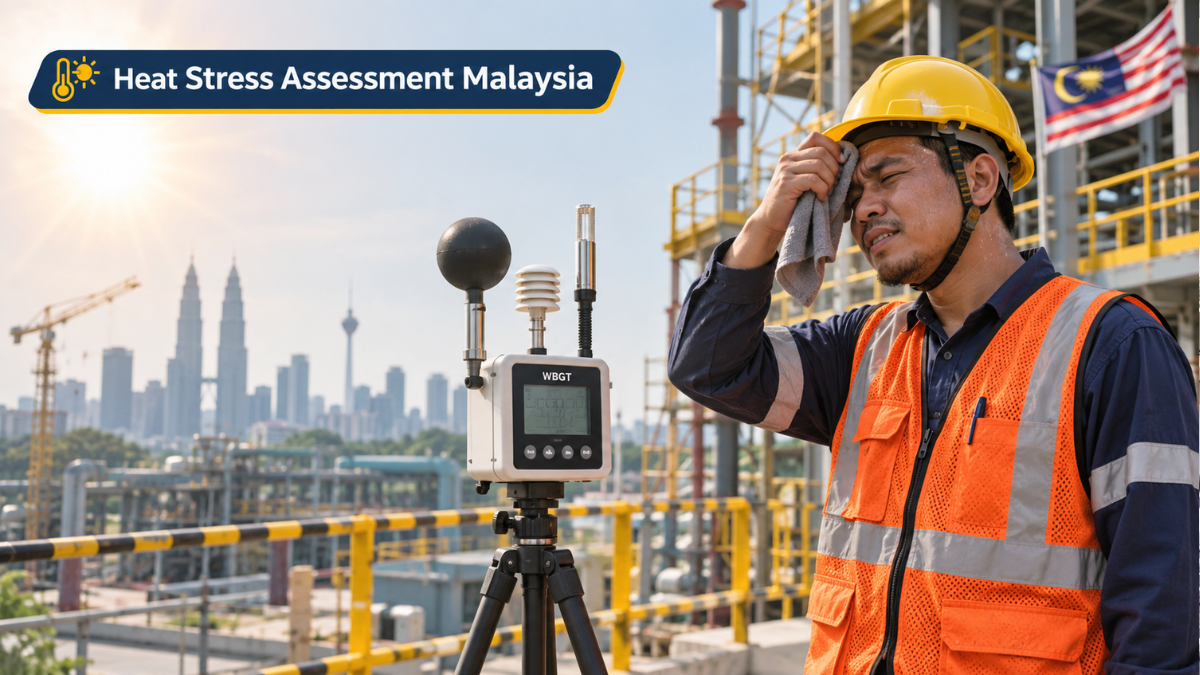
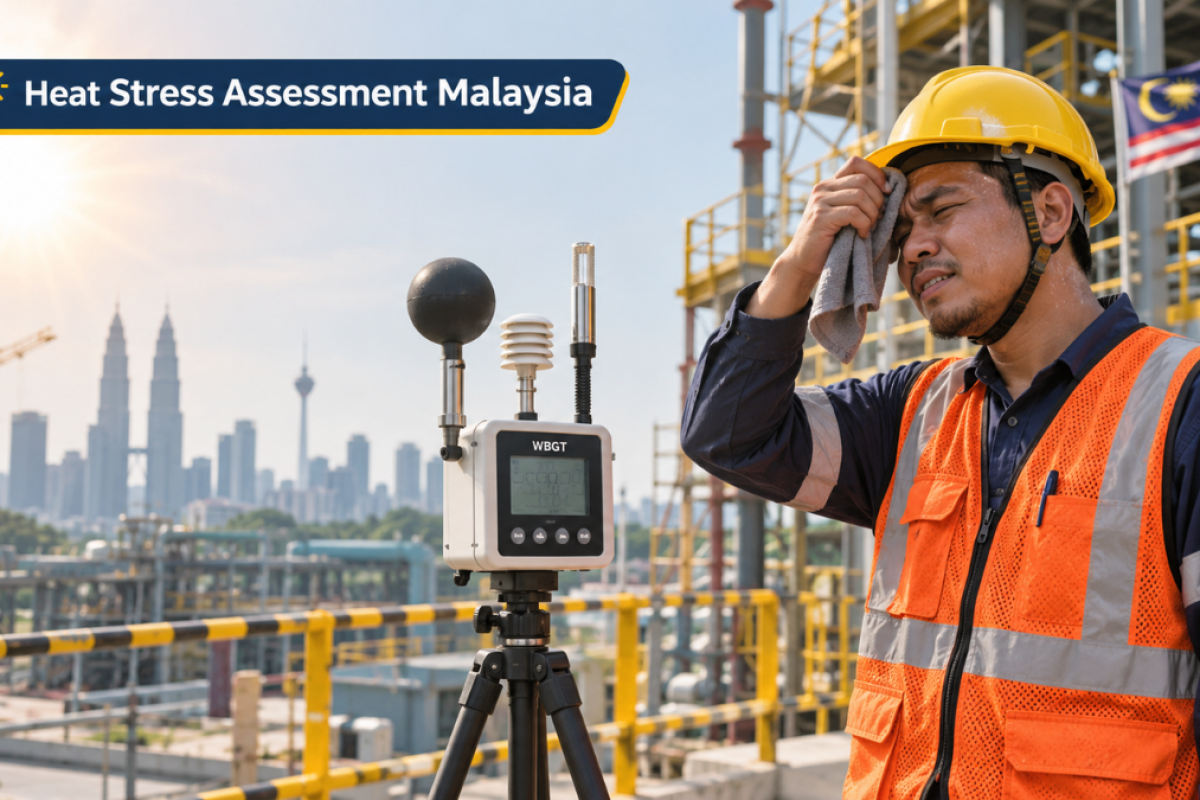
Step 3: Conduct WBGT Measurements
A suitable WBGT meter is used to assess environmental heat conditions.
The DOSH guideline specifies measurement over a total period of one hour corresponding to the expected maximum heat stress, with readings taken at five-minute intervals.
This provides 12 readings within the assessment hour.
Measurements should be made at or close to the employee’s actual working location.
The highest-risk period may be during the hottest part of the day or when heat-generating equipment operates at maximum production load.
The assessor should document instrument information, measurement conditions and calibration status.
Step 4: Determine Metabolic Workload
Heat stress is strongly influenced by physical activity.
Workers undertaking heavy tasks generate more metabolic heat than workers performing light tasks.
DOSH’s guideline identifies general work categories:
| Work category | Examples |
|---|---|
| Light | Seated tasks, light hand work, limited walking |
| Moderate | Normal walking, moderate lifting, sustained arm work |
| Heavy | Shovelling, carrying heavy materials, demanding manual work |
| Very heavy | Very intense physical activity at a high pace |
The work category should reflect actual job activity rather than the employee’s job title alone.
Step 5: Apply Clothing Adjustments
Certain clothing and protective equipment can restrict heat dissipation.
For example, multiple clothing layers, impermeable protective garments or chemical-resistant suits may increase the physiological heat burden.
The assessor should identify applicable clothing adjustment factors and add them to the measured WBGT where appropriate.
Adjusted WBGT = Measured WBGT + Applicable Clothing Adjustment Factor
The selected adjustment must follow the relevant technical guidance. Clothing adjustment factors should not be arbitrarily added together.
Step 6: Evaluate Acclimatisation
Acclimatisation refers to the body’s gradual physiological adaptation to work in hot conditions.
New employees, temporary workers and employees returning after prolonged absence may have reduced heat tolerance.
DOSH explains that heat acclimatisation generally takes approximately seven to fourteen days.
A suitable acclimatisation programme gradually increases work exposure while providing appropriate supervision and recovery.
New or returning workers should not automatically be assigned the same heat exposure as fully acclimatised employees.
Step 7: Compare WBGT With Action Limits and TLVs
After considering clothing, workload and work-rest arrangements, the adjusted WBGT is compared against the relevant screening criteria.
DOSH’s 2016 guidelines reference the ACGIH:
Action Limit (AL): A more conservative screening benchmark, particularly relevant to unacclimatised workers.
Threshold Limit Value (TLV): A screening benchmark intended for appropriately acclimatised workers under the specified conditions.
The benchmarks vary according to workload and the percentage of time spent working during the assessment period.
They are not one universal temperature threshold for every worker.
Example: Workload Changes the WBGT Action Limit
DOSH’s 2016 guideline includes the following historical ACGIH 2015 screening examples for work performed during 75–100% of the assessment hour:
| Workload | Action Limit | TLV |
|---|---|---|
| Light work | 28°C WBGT | 31°C WBGT |
| Moderate work | 25°C WBGT | 28°C WBGT |
These figures demonstrate why workload matters.
A temperature that falls below the screening Action Limit for light work may exceed the Action Limit for moderate work.
Important: These are selected historical reference values from DOSH’s 2016 guideline, not Malaysian statutory maximum temperatures. Actual assessments should verify the applicable benchmark edition, clothing adjustments, acclimatisation and work-rest regime.
Step 8: Classify the Risk
DOSH’s guideline describes three broad risk categories.
Low Risk — Adjusted WBGT Below the Action Limit
Maintain existing precautions and continue monitoring conditions. Additional controls may still be required for vulnerable workers or unusual exposure circumstances.
Medium Risk — Adjusted WBGT Above the Action Limit but Below the TLV
Implement general controls, including worker information and training, hydration arrangements, symptom reporting and suitable health precautions.
High Risk — Adjusted WBGT Above the TLV
Implement stronger job-specific controls. This may require reducing physical workload, adjusting work-rest schedules, providing cooling measures, increasing supervision or temporarily suspending unsafe tasks.
The risk decision should account for the whole exposure situation, not the WBGT figure alone.
Step 9: Implement Heat Stress Controls
The employer should use the assessment findings to select practical controls according to the risk.
Step 10: Verify Effectiveness and Maintain Records
After implementing controls, employers should check whether workers’ exposure has been reduced.
Follow-up WBGT monitoring may be appropriate after engineering changes, changes in workload, altered operating conditions or significant environmental changes.
Heat Stress Control Measures for Employers
Heat stress control should follow a structured approach that prioritises reducing exposure at source.
General Controls
General measures may include:
Providing readily accessible drinking water
Providing worker awareness training
Encouraging early reporting of symptoms
Maintaining suitable rest arrangements
Reviewing employees’ heat exposure patterns
Providing appropriate occupational health support
Monitoring hot-weather conditions
Engineering Controls
Engineering measures may include:
Providing shade or shielding from radiant heat
Installing insulation on hot surfaces
Improving suitable ventilation
Using local cooling systems
Providing air-conditioned recovery areas
Relocating work away from heat sources
Introducing mechanical handling aids
Reducing heat-generating processes where practicable
Administrative Controls
Administrative measures may include:
Scheduling demanding tasks during cooler periods
Implementing work-rest cycles
Rotating tasks where suitable
Introducing acclimatisation programmes
Reducing physical workload
Implementing buddy systems
Increasing active supervision
Limiting exposure duration
Maintaining emergency response arrangements
Establishing site-specific escalation and work-stoppage procedures
Personal Protective Equipment
Where relevant, specialised protection may include cooling garments, reflective protective clothing or other suitable equipment.
However, PPE selection must consider its effect on the worker’s ability to dissipate heat.
Some protective clothing can increase heat stress rather than reduce it.
Specialised PPE should therefore be evaluated as part of the overall control strategy, not used as a substitute for effective engineering and administrative controls.
Heat Stroke, Heat Exhaustion and Emergency Response
Heat-related illnesses may include heat cramps, heat exhaustion, heat syncope and heat stroke.
Possible warning signs include:
Headache
Dizziness
Weakness
Nausea
Muscle cramps
Unusual fatigue
Excessive sweating
Faintness or collapse
Heat stroke is a medical emergency.
Warning signs can include confusion, altered behaviour, seizures, collapse or other neurological symptoms in a worker exposed to heat.
If heat stroke is suspected, employers should immediately activate emergency medical assistance, begin rapid cooling using available safe methods and ensure the worker is not left alone.
Do not wait for a temperature reading before responding to serious symptoms.
Employees should be trained to recognise symptoms in themselves and colleagues.
Heat Stress Assessment Report: What Should Be Included?
A professional Heat Stress Assessment Report should provide clear evidence of the methods used, results obtained and actions required.
The report should include:
Company and workplace details
Assessment scope and objectives
Work areas evaluated
Heat hazard screening results
Description of heat sources
Number of exposed workers
Work activity and exposure duration
WBGT measurement method
Measurement date and time
Instrument make, model and serial number
Calibration information
Natural wet bulb, dry bulb and globe temperature readings
Relative humidity and air velocity where measured
Calculated or measured WBGT values
Clothing adjustment factors
Metabolic workload classification
Work-rest regime
Applicable Action Limit and TLV benchmarks
Risk classification
Existing controls
Recommended additional controls
Corrective action plan
Follow-up monitoring recommendations
The report should make it easy for the employer to understand which work areas require action and why.
Example of an Anonymised WBGT Survey Summary
A genuine WBGT survey table can demonstrate how workplace heat exposure is assessed and interpreted.
For publication, an anonymised survey excerpt should use neutral work area identifiers and remove customer names, addresses, employee identities and confidential production information.
The published summary should show the measured WBGT, relevant clothing adjustment, workload, comparison benchmark and recommended action.
[Insert anonymised real-job WBGT survey table here.]
All results must be sourced from an actual completed assessment, and the interpretation should be checked before publication.
This type of real-world example helps employers understand the connection between numerical measurements and practical risk controls.
What Records Should Employers Maintain?
Employers should maintain suitable records to demonstrate heat stress risk management.
Useful records include:
HIRARC and heat hazard screening
WBGT survey reports
Instrument calibration records
Workload and exposure assessments
Clothing adjustment evaluations
Work-rest schedules
Hydration and recovery arrangements
Heat stress training records
Worker acclimatisation arrangements
Corrective action plans
Follow-up monitoring results
Relevant health surveillance records, handled confidentially
Emergency response procedures
Incident investigation and preventive action records
Records should be maintained according to applicable legal requirements, company policy and risk-management needs.
The DOSH heat stress guideline should not be interpreted as prescribing one universal retention period for all these records.
When Should Heat Stress Assessment Be Repeated?
Employers should review heat exposure when workplace conditions materially change.
Examples include:
Installation of new heat-generating equipment
Changes to production processes
Increased physical workload
Changes in operating hours
Changes in ventilation or cooling systems
New protective clothing
Changes to work-rest schedules
Significant hot-weather episodes
Heat-related complaints or incidents
Findings indicating existing controls are ineffective
A periodic review schedule should also be established based on workplace risk.
Heat stress assessment is not a one-time exercise if exposure conditions continue to change.
Heat Stress Assessment vs HIRARC
HIRARC stands for Hazard Identification, Risk Assessment and Risk Control.
HIRARC provides a general method for identifying hazards and assessing risk.
Heat Stress Assessment provides a more detailed evaluation of occupational heat exposure, including WBGT monitoring and comparison against heat stress benchmarks.
In practice, the two should work together.
HIRARC identifies heat as a workplace hazard. Heat Stress Assessment measures and evaluates exposure where appropriate. The findings should then feed back into the workplace’s risk controls and HIRARC records.
How Advanced HSE Solutions Can Help
Advanced HSE Solutions supports Malaysian employers through Industrial Hygiene Assessment & Monitoring, workplace risk assessment, occupational hygiene advice and DOSH/JKKP compliance preparation.
For workplace heat stress management, our support may include:
Preliminary heat hazard screening
Heat stress assessment planning
Coordination of WBGT monitoring
Review of work activities and exposure duration
Workload and clothing evaluation
Review of existing work-rest practices
Heat stress risk evaluation
Recommendations for engineering and administrative controls
Hydration and recovery area recommendations
HIRARC integration
Documentation and reporting support
Follow-up action planning
Whether your workplace operates a factory, warehouse, construction site, industrial kitchen, boiler room or outdoor work area, our team can help you identify heat exposure concerns and determine the appropriate assessment scope.
Conclusion
Heat Stress Assessment is an important part of occupational health risk management in Malaysia.
Although there is no universal statutory WBGT limit, employers remain responsible for protecting employees from foreseeable heat-related risks under the Occupational Safety and Health Act 1994.
DOSH’s Guidelines on Heat Stress Management at Workplace 2016 provide a structured approach using screening, WBGT measurement, workload assessment, ACGIH reference criteria and suitable control measures.
For employers, the key message is simple: measuring workplace temperature is not enough. Heat exposure must be evaluated together with workload, clothing, acclimatisation and work-rest arrangements.
The goal is not merely to obtain a WBGT report, but to use its findings to protect workers and maintain a safer working environment.
FAQ
What is Heat Stress Assessment in Malaysia?
Heat Stress Assessment evaluates workplace heat exposure to identify conditions that may affect workers’ health and safety. It may involve hazard screening, WBGT measurement, workload evaluation, risk classification and control recommendations.
What does WBGT stand for?
WBGT stands for Wet Bulb Globe Temperature. It is an index used to evaluate occupational heat stress by considering environmental heat factors including humidity, radiant heat and air temperature.
Is Heat Stress Assessment mandatory under DOSH?
Malaysian employers have legal duties to assess and control workplace safety and health risks. DOSH’s 2016 heat stress guidelines provide technical guidance for meeting these duties, although the guidelines’ numerical ACGIH benchmarks are not themselves universal statutory heat limits.
What is the WBGT limit in Malaysia?
There is no single universal statutory WBGT limit for all Malaysian workplaces. DOSH’s guidelines use ACGIH Action Limits and TLVs that vary according to workload, work-rest regime and worker acclimatisation.
What is the difference between WBGT Action Limit and TLV?
The Action Limit is a more conservative benchmark, especially relevant to unacclimatised workers. The TLV is a screening benchmark for appropriately acclimatised workers under specified exposure conditions.
How is WBGT measured?
WBGT is measured using suitable equipment with natural wet bulb, globe and dry bulb temperature sensors as applicable. The DOSH guideline describes an assessment using a one-hour exposure period with readings at five-minute intervals.
Can outdoor temperature forecasts replace WBGT measurements?
No. Weather forecasts provide general environmental information but do not fully reflect workplace radiant heat, humidity, workload, clothing or local exposure conditions.
Which workplaces need heat stress monitoring?
Heat stress monitoring may be appropriate in manufacturing plants, foundries, boiler rooms, construction sites, warehouses, industrial kitchens, agricultural activities and other workplaces with potentially excessive heat exposure.
How often should heat stress assessment be reviewed?
Heat stress assessment should be reviewed when exposure conditions change, following relevant incidents or complaints, and according to a risk-based monitoring programme.
Can Advanced HSE Solutions help with Heat Stress Assessment?
Advanced HSE Solutions supports heat stress monitoring and occupational hygiene management, including heat hazard review, assessment planning, monitoring coordination, risk control recommendations and compliance documentation.